Why DOFR Errors Don't Generate Denials
Most healthcare payment errors generate denials. DOFR configuration errors don't. Learn why claims systems can't detect these hidden financial responsibility mistakes, and why they often remain invisible for months.

Most payment errors in healthcare announce themselves.
A coding error creates a denial.
An eligibility problem creates a denial.
Missing prior authorization creates a denial.
Someone notices.
Someone investigates.
Someone fixes it.
DOFR configuration errors behave very differently.
They process successfully.
They get paid.
The month closes.
And the wrong organization quietly absorbs a cost it was never supposed to bear.
This is not a flaw in the claims system. It is how the system was designed. And it is why DOFR misconfiguration is one of the most financially dangerous categories of administrative error in delegated risk.
Why Don't DOFR Errors Generate Denials?
A denial only occurs when the claims system can compare a claim against an authoritative source.
Examples include:
- Eligibility → Member database
- Coding → NCCI edits
- Prior Authorization → Authorization records
Each of these has something the system can validate against.
DOFR responsibility does not.
The claims system simply executes the financial responsibility rules that have been configured. It does not compare those rules against the signed DOFR exhibit or delegation agreement.
If the configuration is wrong, the system has no way to know.
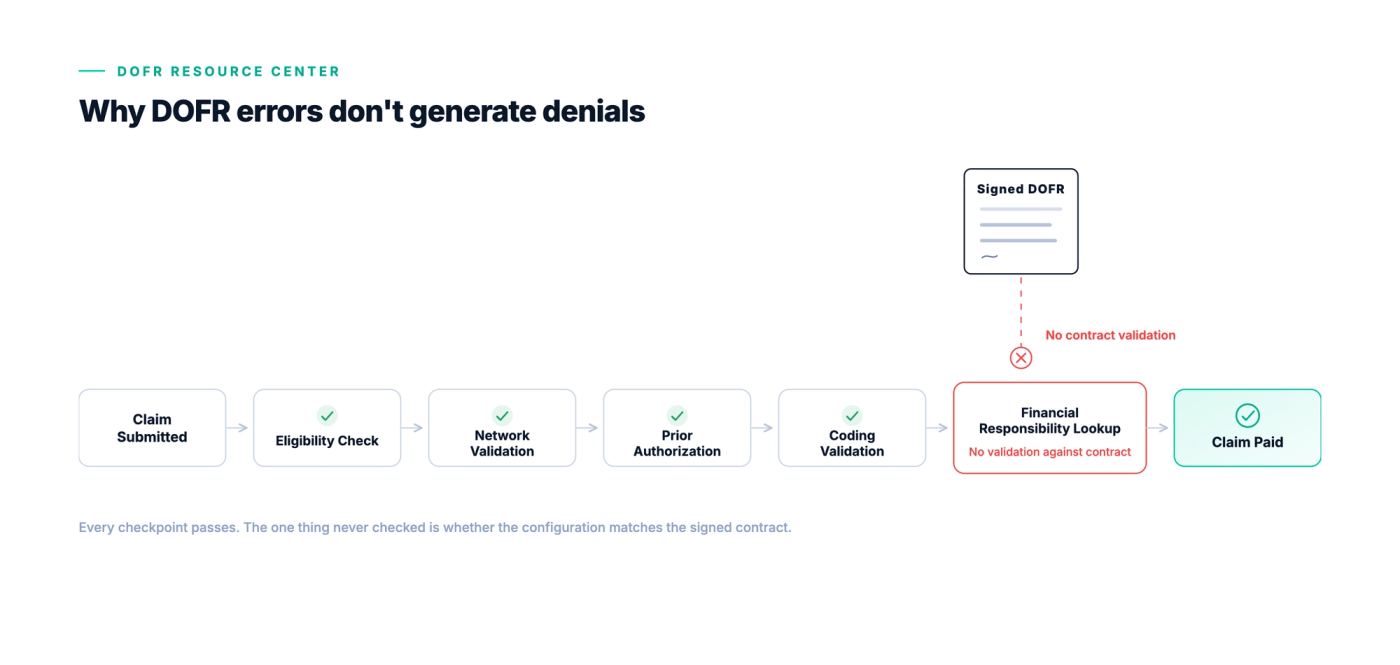
The Mechanism
To understand why DOFR errors remain invisible, it helps to understand what a claims adjudication platform is actually checking.
When a claim enters a platform such as QNXT, HealthEdge, or Facets, it passes through a series of validation gates.
Is the member eligible?
If not, the claim is denied.
Is the provider in network?
If not, the claim is denied or flagged.
Is prior authorization on file?
If not, the claim is denied.
Are the diagnosis and procedure codes valid?
If not, the claim is denied.
Which organization is financially responsible?
The system looks up the configured DOFR rule and assigns responsibility.
There is no validation against the contract.
The system simply executes whatever responsibility rules exist in configuration.
Correct or incorrect.
The claim is paid.
Why No Operational Signal Exists
Eligibility failures generate alerts because the system can compare a claim against a member database.
Coding edits generate alerts because the system can compare procedure codes against established rules.
Prior authorization generates alerts because the system can compare the claim against authorization records.
DOFR configuration has no comparable reference point.
The signed DOFR exhibit lives in a contract repository or shared drive.
The configuration lives inside the claims system.
Nothing automatically compares the two.
As a result, a claim can be assigned to the wrong financially responsible party, processed successfully, paid, and closed without generating a denial, an exception report, or an operational alert.
What This Looks Like in Practice
Imagine a medical group that accepts financial responsibility for injectable medications under one payer contract.
Under a different payer, those same medications remain the health plan's responsibility.
If the claims configuration accurately reflects both contracts, claims route correctly.
But imagine one configuration was never updated after a quarterly DOFR amendment.
Or perhaps it was originally configured by an employee who has since left the organization.
The claims continue processing normally.
Patients receive care.
Providers are paid.
Nothing appears unusual.
Yet every affected claim is being assigned to the wrong financially responsible organization.
No denial is generated.
No work queue appears.
No one knows until financial reconciliation uncovers the discrepancy—if it ever does.
The Reconciliation Problem
Most organizations discover DOFR configuration errors during financial reconciliation.
That creates two significant challenges.
Timing
Reconciliation often occurs quarterly or semi-annually.
By the time an error is identified, it may have affected hundreds or thousands of claims.
Recovering those payments is difficult, time-consuming, and frequently damages payer-provider relationships.
Cost
Manual reconciliation is expensive.
Claims teams must:
- Review individual claims
- Compare them to the DOFR
- Determine correct financial responsibility
- Calculate the financial impact
- Document the recovery
For many organizations, the administrative cost approaches the value of what they recover.
As a result, smaller errors often remain unresolved—even though their cumulative financial impact can be substantial.
Why This Problem Is Getting Worse
Three industry trends are increasing the likelihood of DOFR configuration errors.
Workforce Turnover
Experienced analysts leave with years of undocumented institutional knowledge.
The people who inherit the system often inherit configuration they did not create and cannot fully explain.
Quarterly DOFR Updates
DOFRs change regularly.
New medications.
Biosimilars.
Regulatory updates.
Benefit changes.
Capitation adjustments.
Organizations managing dozens of payer contracts may implement hundreds of configuration changes every quarter.
Each change creates another opportunity for silent error.
Growth of Delegated Risk
Delegated risk continues expanding across Medicare Advantage, Medicaid managed care, commercial value-based arrangements, and accountable care organizations.
More delegation means:
- More contracts
- More DOFRs
- More payer relationships
- More configuration
- More opportunities for misalignment
How Other Industries Handle This
Healthcare is not unique in relying on system configuration to execute contractual obligations.
Financial services reconcile trade settlements against contractual terms.
Insurance platforms validate policy configuration against underwriting rules.
Manufacturing systems verify production instructions against engineering specifications.
In each case, organizations maintain a connection between operational configuration and the authoritative source document.
When those drift apart, an exception is generated.
Healthcare generally lacks this capability for DOFR configuration.
The signed contract and the claims system configuration typically exist in separate systems with no automated comparison between them.
What Would Change If DOFR Errors Were Visible?
If organizations could identify configuration mismatches before large numbers of claims were processed, several things would change.
Reconciliation Becomes Validation
Instead of discovering problems months later, reconciliation confirms that configuration remains accurate.
Recovery Becomes Simpler
Errors caught early involve fewer claims, less administrative effort, and fewer disputes.
Provider Friction Decreases
Correct financial responsibility means fewer delayed payments, fewer disputes, and better payer-provider relationships.
Institutional Knowledge Matters Less
Configuration becomes easier to understand and maintain because it can be evaluated against documented contractual requirements rather than relying solely on individual expertise.
The Bottom Line
DOFR errors don't generate denials because claims systems were designed to execute financial responsibility rules—not validate those rules against the underlying contract.
Every other major category of payment error has an independent validation mechanism.
DOFR configuration generally does not.
That is why these errors remain invisible.
That is why they compound over time.
And that is why improving the alignment between contractual responsibility and operational configuration is becoming increasingly important as delegated risk continues to expand.
Continue Learning
Read the companion article:
What Is a DOFR? The Complete Guide to Division of Financial Responsibility
Explore additional resources in the DOFR Resource Center.