The Three-Way Model: How Financial Responsibility Actually Splits in Delegated Risk
Most people think delegated risk is a two-party relationship between a health plan and a medical group. In reality, financial responsibility is split three ways across medical groups, health plans, and specialty vendors; and understanding that model is essential to understanding DOFRs.

Most people think delegated risk is a financial relationship between two organizations.
A health plan.
And a medical group.
Operationally, that's not how delegated risk actually works.
Every DOFR is a map of financial responsibility across three parties:
- the medical group or IPA,
- the health plan,
- and one or more specialty vendors.
Understanding that three-way model is the key to understanding why delegated risk becomes operationally complex, and why so many DOFR configuration errors occur.
Most people who work with DOFRs think of financial responsibility as a two-party question.
Either the medical group pays.
Or the health plan pays.
That model is incomplete.
Financial responsibility in delegated risk splits three ways. And the third party, the carved-out specialty vendor, is where some of the most expensive configuration errors hide.
Understanding the three-way model is not academic.
It is the foundation for every DOFR matrix, every claims configuration decision, and every quarterly update an operations team makes.
Getting it wrong means claims are paid by the wrong organization, silently, with no denial and no alert.
What Is the Three-Way Model?
The three-way model is the financial responsibility framework used in every DOFR matrix. It assigns each healthcare service category to one of three responsible parties: the medical group or IPA (capitated responsibility), the health plan (plan risk), or a third-party specialty vendor (carved-out responsibility).
Every claim that enters a delegated risk arrangement must be assigned to one of these three parties. The DOFR matrix is the document that makes that assignment. The claims adjudication system is the software that executes it.
The three parties are not interchangeable. Each has a different economic relationship to the claim, a different payment mechanism, and a different operational workflow. Confusing one for another, or configuring a service under the wrong party, produces errors that are invisible to the claims system.
---
Figure 1. The Three-Way Model of Financial Responsibility
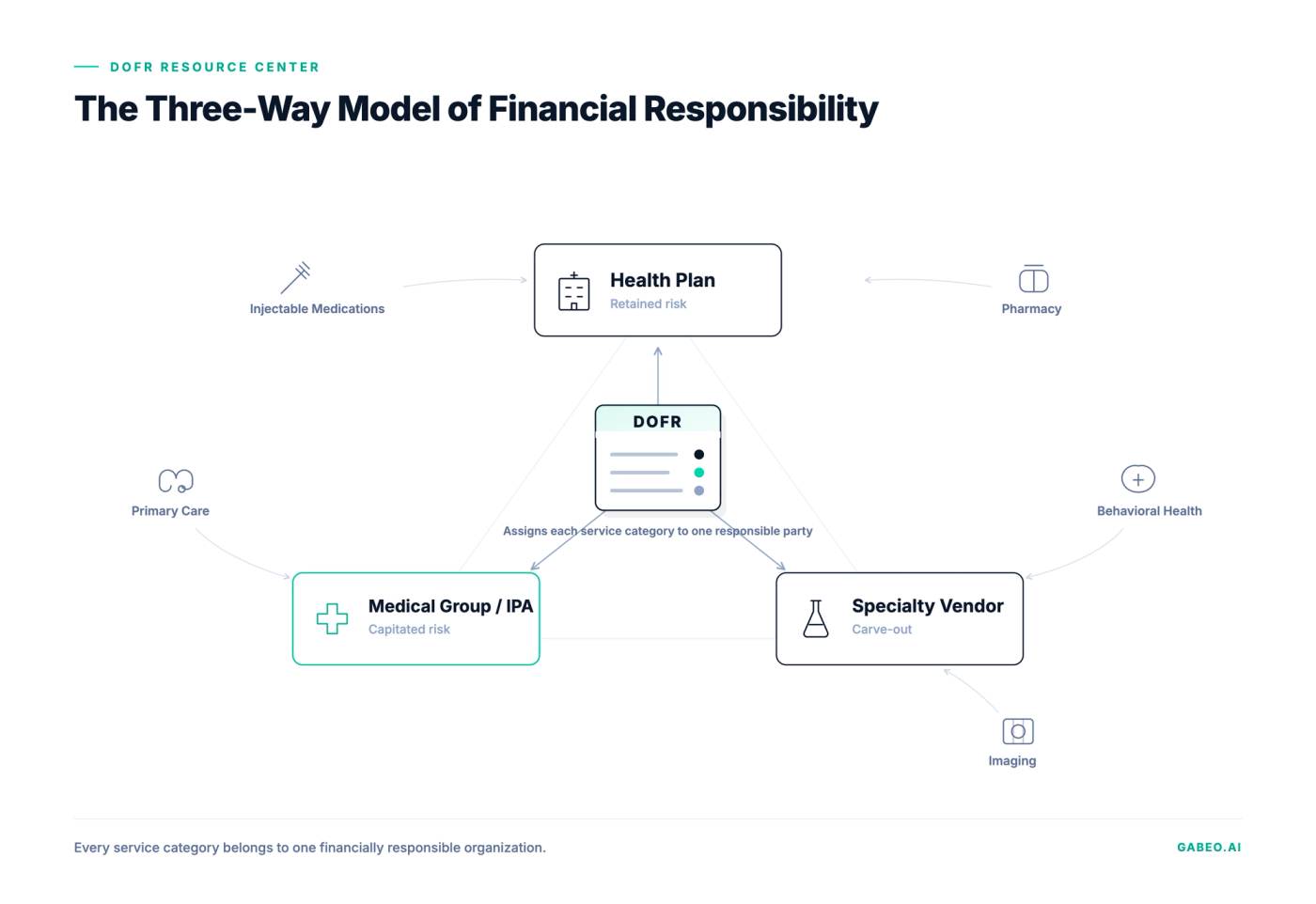
Every healthcare service category in a DOFR is assigned to exactly one financially responsible party: the medical group or IPA, the health plan, or a specialty carve-out vendor.
---
How Does Capitated Responsibility Work?
When a service category is assigned to the medical group or IPA, the group bears full financial risk. The health plan pays the group a fixed per-member-per-month (PMPM) capitation amount, and the group is responsible for covering the cost of those services out of that payment.
If actual costs come in below the capitation amount, the group keeps the surplus.
If actual costs exceed capitation, the group absorbs the loss.
This is the core economic engine of delegated risk. The group is incentivized to manage care efficiently because every dollar saved flows directly to the group's bottom line.
Common capitated service categories include:
- Primary care physician visits
- Specialist office visits
- Outpatient facility services
- Injectable medications (varies by contract)
- Diagnostic testing (varies by contract)
The specific services that fall under capitation vary significantly across payer contracts. A service that is capitated under one health plan relationship may be plan risk under a different relationship with a different payer.
This is why DOFR configuration cannot be set once and applied universally. Each payer relationship requires its own configuration. Each configuration must match its own specific DOFR exhibit.
What Is Plan Risk?
Plan risk means the health plan retains financial responsibility for a service category. The plan did not delegate that risk to the medical group. The plan pays claims for those services directly.
This is an important distinction that practitioners sometimes miss: plan risk is not a carve-out. No third party is involved. The plan simply chose not to delegate financial responsibility for certain services.
Common plan risk service categories include:
- Out-of-area emergency services
- Certain high-cost procedures
- Transplant services
- Services where the plan determined delegation was not appropriate
- Newly introduced services not yet incorporated into the capitation rate
When a service is classified as plan risk, the medical group's PMPM capitation rate does not include the expected cost of those services. The economics are clean: the group is not paid to cover them, and the group does not bear risk for them.
The configuration challenge arises when a service moves between capitated and plan risk during a quarterly DOFR update. If the claims system is updated but the capitation rate is not (or vice versa), one party is absorbing costs it should not be.
How Do Carve-Outs Work?
Carved-out services are removed from the medical group's capitation and managed by a separate specialty vendor. The vendor receives its own payment arrangement (often its own capitation or fee schedule) and assumes responsibility for those services.
Common carve-outs include:
- Behavioral health, managed by a Managed Behavioral Health Organization (MBHO) such as MHN or Beacon Health
- Pharmacy benefits, managed by a Pharmacy Benefit Manager (PBM) such as CVS Caremark or Express Scripts
- Dental, managed by carriers like Delta Dental
- Vision, managed by carriers like VSP
- Non-emergency medical transportation (NEMT)
- Certain high-cost specialty drugs
- Dialysis services
When a service is carved out, the medical group's PMPM capitation decreases to reflect the reduced scope of risk. The carve-out vendor becomes the financially responsible party for those services.
Carve-outs create a specific configuration challenge: the boundary between what is carved out and what remains capitated or plan risk is often defined by drug codes, procedure codes, or diagnosis codes that change quarterly. A new biologic that launches mid-year may fall into the carve-out vendor's scope under one contract but remain capitated under another.
If the configuration does not precisely reflect those boundaries, claims cross the line. The group pays for services the carve-out vendor should cover, or the carve-out vendor is billed for services the group agreed to capitate.
Nobody sees it happen.
Why Does the Same Service Fall Under Different Parties for Different Payers?
This is the operational reality that makes DOFR configuration so difficult: the same healthcare service can be assigned to different responsible parties depending on which payer contract applies.
Injectable medications are the most common example.
Under a contract with Health Plan A, injectable medications may be capitated to the medical group. The group receives a higher PMPM rate to account for this risk.
Under a contract with Health Plan B, those same injectable medications may be plan risk. The group receives a lower PMPM rate, and the plan pays injectable claims directly.
Under a contract with Health Plan C, some injectables may be carved out to a specialty pharmacy vendor while others remain capitated.
One medical group.
Three payer contracts.
Three different financial responsibility assignments for the exact same service.
---
Figure 2. The Same Service Can Have Different Financial Owners
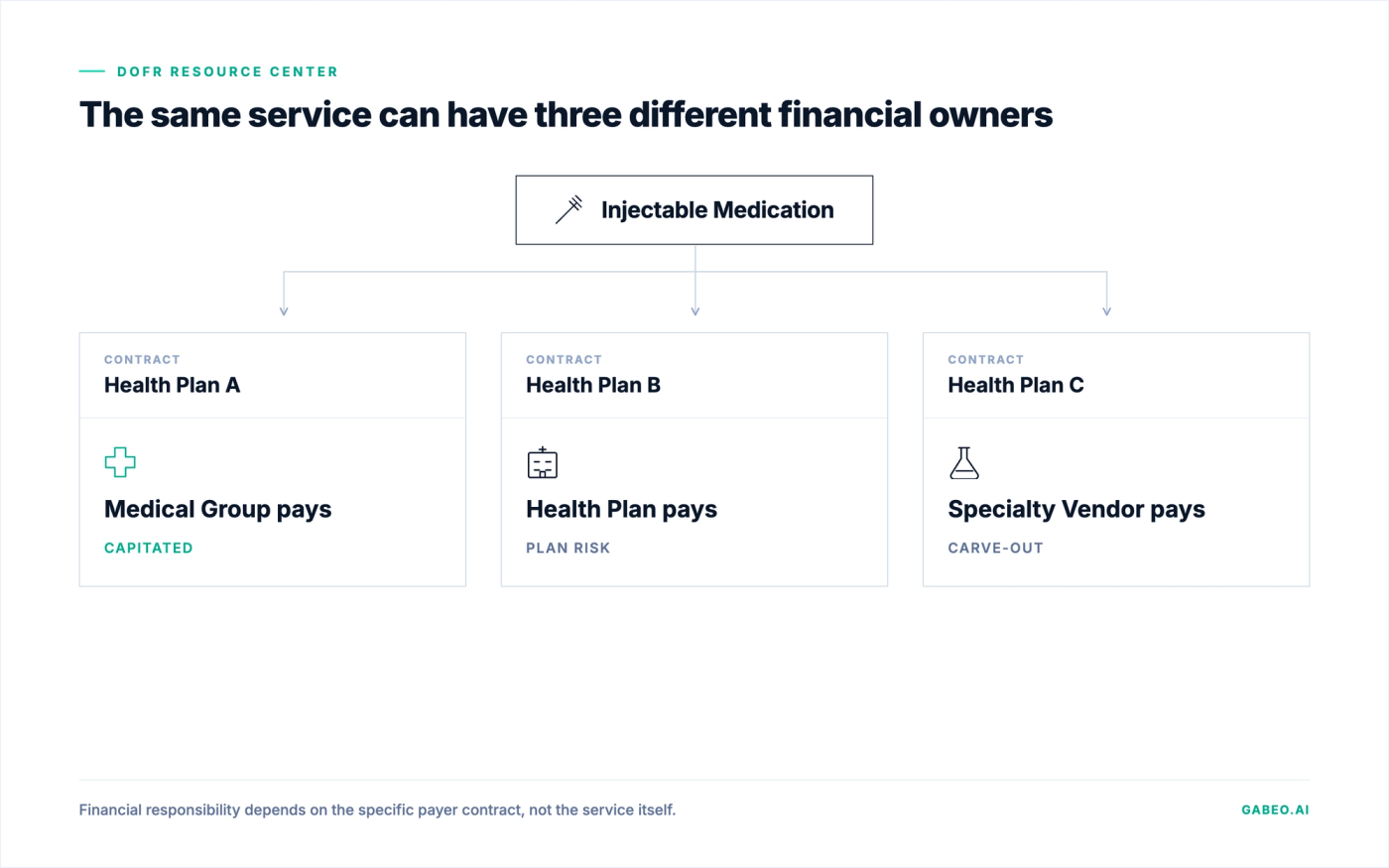
Financial responsibility depends on the specific payer contract, not on the healthcare service itself.
---
The claims system must be configured correctly for each payer relationship independently. A single configuration that applies across all payers will be wrong for at least two of them.
This is why organizations managing 30 or 40 payer contracts face hundreds of configuration variables. Each variable is an opportunity for error. Each error is invisible.
Where Do Three-Way Model Errors Typically Occur?
Configuration errors in the three-way model tend to concentrate in specific scenarios. Understanding these patterns helps organizations focus their validation efforts.
Carve-out boundary drift
Carve-out scope changes over time as new drugs, procedures, and benefits are added. When the boundary between carved-out and capitated services shifts but the configuration does not, claims land on the wrong side.
A new specialty biologic launches. The carve-out vendor adds it to their formulary. But the medical group's claims configuration still has that drug's J-code mapped to capitated responsibility. The group absorbs costs the carve-out vendor should be covering.
Plan risk to capitated transitions
When a service category moves from plan risk to capitated responsibility during a contract renewal or amendment, the PMPM rate should increase to reflect the additional risk. If the claims configuration is updated but the rate is not, the group is covering services without being compensated. If the rate is updated but the configuration is not, the plan is still paying claims the group should be covering.
Both scenarios are invisible to the claims system.
Quarterly crosswalk updates
Health plans publish quarterly crosswalks, like Health Net's Injectable Medication HCPCS/DOFR Crosswalk, that map new and changed drug codes to DOFR categories. When a crosswalk adds 15 new HCPCS codes and the configuration team applies 14 of them correctly, the one they missed creates a silent error stream for every claim with that code.
Multi-contract inconsistency
When the same service category has different responsibility assignments across different payer contracts, configuration teams must maintain distinct rule sets for each relationship. Copying a configuration from one payer contract and applying it to another, even between similar contracts, introduces errors wherever the DOFRs differ.
How Does the Three-Way Model Affect Capitation Rate Calculations?
The PMPM capitation rate is directly tied to the scope of services the medical group agrees to cover. As services move between the three responsibility categories, the rate must adjust accordingly.
When a service is carved out, the PMPM decreases. The group is no longer bearing risk for those services.
When a carved-out service returns to capitation (a "carve-in"), the PMPM should increase. The group is now covering additional services.
When a plan risk service transitions to capitated responsibility, the same adjustment should occur.
For example, if a DOFR amendment shifts $3.25 PMPM of cost responsibility to the medical group, the capitation rate should increase by a corresponding amount. When it does not, the group absorbs an unplanned loss on every member, every month, until someone notices.
The financial exposure compounds quickly. A $3.25 PMPM gap across 10,000 members is $32,500 per month, or $390,000 per year.
How Many Columns Does a Real DOFR Matrix Have?
Most people picture a DOFR as a simple two-column table: one column for the group, one for the plan. In practice, DOFR matrices often have three or more columns.
A basic three-party matrix has columns for:
1. Medical Group / IPA Responsibility
2. Health Plan Responsibility
3. Specialty Vendor Responsibility
More complex arrangements may include additional columns for:
- Split capitation
- Subcapitation
- Multiple carve-out vendors
- Shared specialty risk arrangements
The more columns in the matrix, the more configuration rules in the claims system. The more rules, the more opportunities for error. The more errors, the more financial exposure accumulates silently.
Frequently Asked Questions
What is the three-way model in a DOFR?
The three-way model divides financial responsibility among three parties: the medical group or IPA (capitated), the health plan (plan risk), and third-party specialty vendors (carved out). Each service category in the DOFR matrix is assigned to one of these three.
What is the difference between plan risk and a carve-out?
Plan risk means the health plan retains financial responsibility directly. A carve-out means responsibility has been transferred to a third-party specialty vendor, such as a pharmacy benefit manager or a managed behavioral health organization.
Why does the same service have different responsible parties under different payer contracts?
Each delegation agreement includes its own DOFR exhibit. Responsibility assignments depend on the negotiated terms of that contract, the capitation rate, and the scope of delegated services.
How do carve-out boundaries change over time?
Carve-out boundaries evolve as new drugs, procedures, and benefit categories are introduced. Quarterly crosswalks require corresponding updates to claims configuration.
What happens when the capitation rate does not match the DOFR configuration?
When financial responsibility changes but capitation does not, one organization absorbs costs it was never compensated to cover. These mismatches often remain undetected until financial reconciliation.
The Bottom Line
Delegated risk is often described as a relationship between a health plan and a medical group.
Operationally, it is something more complex.
Every DOFR is a three-way allocation of financial responsibility among:
- the medical group,
- the health plan,
- and specialty vendors.
That complexity isn't the problem.
Unvalidated configuration is.
When every payer contract has its own responsibility model, accuracy depends on ensuring that claims-system configuration faithfully reflects each contract.
That's where delegated risk succeeds, or quietly leaks money.
Continue Learning
- What Is a DOFR? The Complete Guide
- Why DOFR Errors Don't Generate Denials
- Explore the DOFR Resource Center
Subscribe to the DOFR Benchmark Report to receive original research and data on DOFR configuration accuracy across the industry.