Provider Abrasion and DOFR: The Hidden Source of Network Friction
Provider abrasion is usually blamed on prior authorization, claims denials, or credentialing delays. In delegated risk, inaccurate DOFR configuration creates a different type of provider friction that rarely appears in operational metrics but can quietly affect many import outcomes.

Provider abrasion is one of the most persistent challenges in healthcare operations. Health plans invest heavily in reducing it. Provider relations teams monitor it. Regulators increasingly expect organizations to demonstrate that they are maintaining healthy provider networks while minimizing unnecessary administrative burden.
When healthcare leaders discuss provider abrasion, the conversation usually centers on familiar issues such as prior authorization, claims denials, credentialing delays, and reimbursement disputes. Those are all legitimate sources of friction.
They also have something in common.
Each one generates an operational signal.
A denied claim appears in reporting. A prior authorization delay can be measured. Credentialing bottlenecks create visible work queues. Organizations can identify these problems, assign resources, and measure improvement over time.
There is another source of provider abrasion that rarely appears on operational dashboards. It generates no denial, no exception report, and no obvious indication that anything is wrong. Yet it can quietly affect provider payments, increase administrative work, strain relationships between health plans and medical groups, and create financial pressure that spreads throughout a delegated risk network.
That source is inaccurate Department of Financial Responsibility (DOFR) configuration.
In delegated risk arrangements, the DOFR defines which organization is financially responsible for each category of healthcare services. When those responsibility assignments are translated incorrectly into claims adjudication systems, providers may experience slower payments, additional follow-up work, and growing frustration without ever realizing the underlying cause.
Unlike traditional provider abrasion, this type of friction often remains hidden until financial reconciliation uncovers the discrepancy months later.
Understanding this operational pathway is becoming increasingly important as delegated risk expands across Medicare Advantage, Medicaid managed care, and commercial value-based care arrangements.
What Is Provider Abrasion?
Provider abrasion refers to the cumulative operational friction providers experience when interacting with health plans, delegated entities, and payment systems. It includes every unnecessary process that delays reimbursement, increases administrative work, or makes it more difficult for providers to deliver care efficiently.
Common examples include:
- Prior authorization delays
- Claims denials and appeals
- Eligibility verification issues
- Credentialing delays
- Payment disputes
- Manual claims rework
- Complex reimbursement policies
While each of these issues affects providers differently, they all increase administrative burden and reduce confidence in the organizations responsible for paying claims.
The consequences extend well beyond operational inconvenience.
When provider abrasion becomes severe or persistent, physicians and facilities may reconsider participating in a network. Recruiting replacement providers is expensive, maintaining network adequacy becomes more difficult, and patients experience disruptions in access to care.
Industry research has increasingly focused on measuring provider friction across operational domains such as eligibility verification, claims management, payment integrity, and administrative complexity. These measurement frameworks reinforce an important lesson.
Operational friction rarely begins where providers experience it.
Instead, many downstream problems originate much earlier in the payment process, where contractual obligations, financial responsibility, and claims configuration intersect.
Delegated risk provides one of the clearest examples of this principle.
Why Delegated Risk Changes the Problem
Traditional fee-for-service reimbursement involves two primary financial parties.
A provider submits a claim.
The payer determines whether the claim should be paid.
Disagreements typically involve coding, medical necessity, eligibility, or contract interpretation. Although these disputes can be frustrating, both parties generally understand who is responsible for resolving them.
Delegated risk introduces another layer of complexity.
Instead of paying every covered service directly, a health plan delegates financial responsibility for defined categories of healthcare services to an independent practice association (IPA), medical group, or other risk-bearing organization through a capitated arrangement.
The accompanying DOFR defines exactly which services remain the health plan's responsibility and which services become the delegated organization's responsibility.
As we discussed in The Three-Way Model: How Financial Responsibility Actually Splits, financial responsibility often extends beyond two organizations. Many services are also carved out to specialized vendors responsible for behavioral health, transplant services, specialty pharmacy, vision, dental, and other categories.
Financial responsibility therefore operates across multiple organizations simultaneously.
That means providers are often interacting with a payment system whose financial rules originate in contracts they never see.
Most providers have little visibility into the DOFR governing their claims. They do not know when quarterly crosswalk updates change service category assignments. They do not know whether new procedure codes have been mapped correctly. They simply expect payment to follow the contractual responsibilities established between the health plan and the delegated organization.
When those responsibilities are translated accurately into claims systems, providers rarely notice.
When they are not, providers often experience the consequences long before anyone identifies the operational cause.
How DOFR Configuration Can Create Provider Abrasion
DOFR configuration does not directly determine provider satisfaction.
It determines financial responsibility.
Financial responsibility influences nearly every downstream payment workflow.
When a DOFR is configured accurately, claims move through adjudication according to the contractual responsibilities agreed upon by the health plan and the delegated organization.
When configuration no longer reflects the current agreement, several operational problems can emerge.
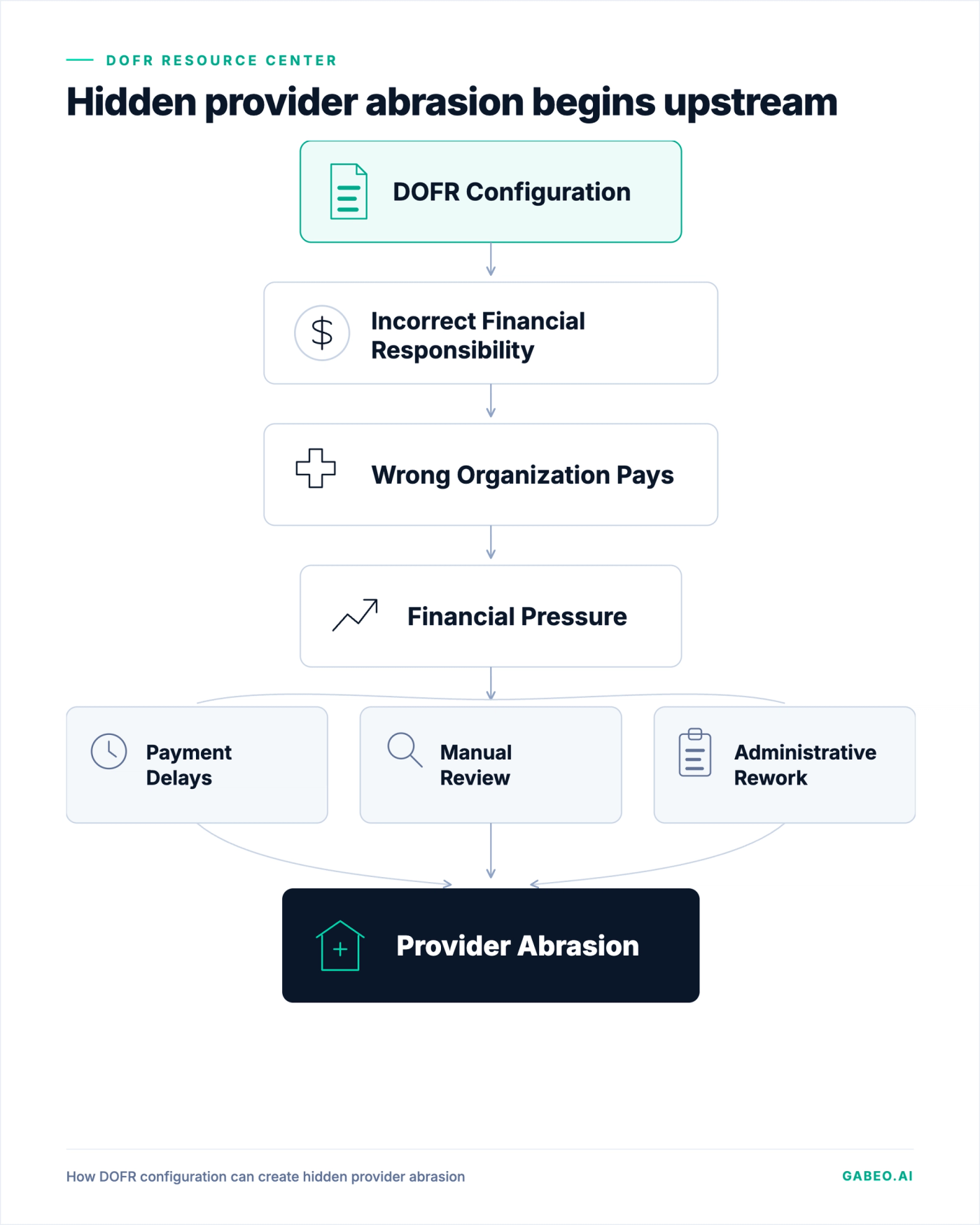
One common pathway involves incorrect financial responsibility assignment.
Suppose a quarterly DOFR crosswalk moves a category of injectable medications from delegated risk back to health plan responsibility. If the claims adjudication system is not updated accordingly, the medical group may continue paying claims that should now be paid by the health plan.
The provider still receives payment.
No denial is generated.
No exception report identifies the incorrect financial responsibility assignment.
The financial error remains largely invisible until reconciliation.
Another pathway involves manual claims review.
When financial responsibility cannot be determined confidently because service category rules are incomplete, ambiguous, or outdated, claims may require additional operational review before payment. Even modest increases in manual review can extend payment timelines, increase administrative workload, and create additional follow-up activity for provider offices attempting to understand payment status.
A third pathway develops more gradually.
If a delegated organization consistently absorbs expenses that belong to the health plan, its financial position can deteriorate over time. Leadership may respond by tightening utilization management, slowing discretionary spending, increasing payment oversight, or adopting more conservative reimbursement practices.
Providers experience these changes as growing administrative friction.
Few recognize that the underlying financial pressure may have originated with inaccurate financial responsibility assignments months earlier.
This distinction matters because it shifts the conversation from symptoms to mechanisms.
Most organizations measure provider abrasion after providers begin experiencing it.
DOFR accuracy addresses one potential source much earlier, before operational friction has an opportunity to spread throughout the delegated payment ecosystem.
______________________________________________
Why DOFR-Related Provider Abrasion Is Difficult to Measure
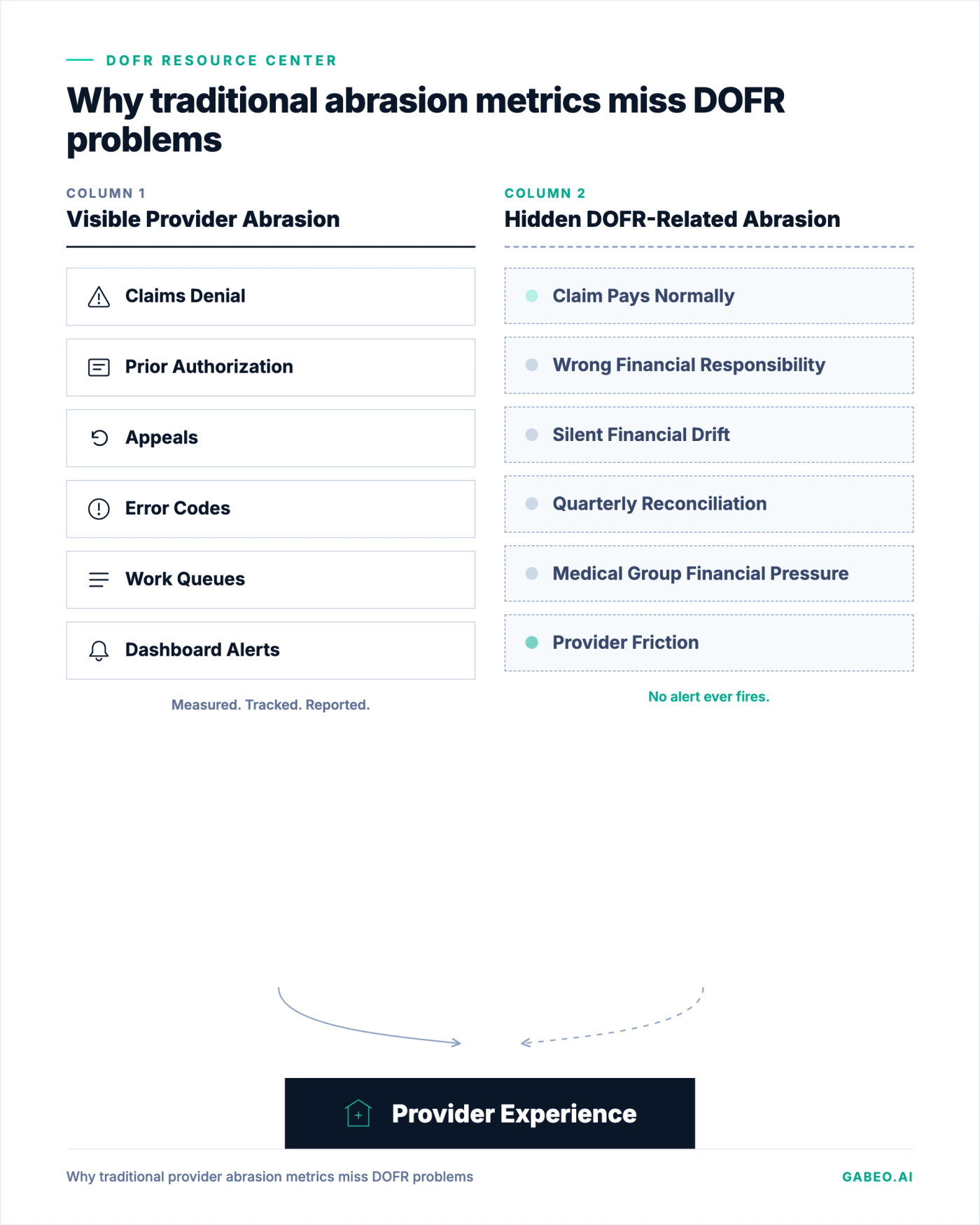
Most organizations measure provider abrasion using operational metrics that generate visible signals.
Examples include:
- Claims denial rates
- Prior authorization turnaround times
- Claims payment timeliness
- Provider complaint volume
- Call center activity
- Appeals and grievances
These are valuable operational indicators.
They also assume the problem creates an observable event.
DOFR configuration errors often do not.
When financial responsibility is assigned incorrectly, the claim is usually still adjudicated.
It is still paid.
It is still closed.
The only difference is that payment comes from the wrong organization.
The medical group absorbs an expense that belongs to the health plan.
The health plan pays for a service that should have remained under delegated risk.
A carved-out vendor is bypassed entirely.
Operationally, the claim appears successful.
Financially, responsibility has been assigned incorrectly.
This creates an important measurement gap.
Traditional provider abrasion metrics are designed to identify workflow failures.
DOFR-related provider abrasion often begins with financial responsibility errors that remain invisible to those workflows.
By the time providers begin noticing slower payments, additional follow-up, or changing utilization management practices, the underlying configuration issue may have existed for months.
One incorrect service category rarely creates a crisis.
Hundreds of incorrectly assigned services across multiple payer contracts can quietly reshape the financial position of a delegated organization.
The operational consequences rarely appear all at once.
Instead, they accumulate.
A quarterly crosswalk update is missed.
Financial responsibility shifts.
Claims continue processing.
The medical group gradually absorbs costs it should not be covering.
Leadership responds to growing financial pressure.
Providers experience slower payment cycles, tighter utilization management, or increasing administrative effort.
Everyone sees the symptoms.
Very few organizations connect them back to financial responsibility configuration.
That is what makes this form of provider abrasion uniquely difficult to identify.
When Provider Abrasion Becomes Financial and Legal Risk
Provider abrasion is often discussed as a relationship problem.
In delegated risk, it can also become a financial governance problem.
Medical groups operating under capitation are expected to manage finite financial resources while meeting contractual obligations to providers, health plans, and regulators.
When financial responsibility assignments are inaccurate, those financial assumptions begin to drift.
Claims expense may gradually exceed expectations.
IBNR estimates may no longer reflect actual responsibility.
Cash reserves can become strained.
None of these outcomes automatically result from a DOFR configuration issue.
However, inaccurate financial responsibility assignments can contribute to each of them if they persist long enough and affect enough claims.
California provides an important example.
As discussed in Value-Based Care in California: What the DMHC Expects from Delegated Risk Organizations, risk-bearing organizations are required to maintain financial solvency standards, timely claims payment performance, and adequate financial reporting.
Each of those measurements depends on understanding which organization is actually responsible for paying which services.
The California Supreme Court reinforced another important principle in Centinela Freeman Emergency Medical Associates v. Health Net of California.
The Court concluded that delegation does not automatically eliminate a health plan's responsibility when delegated financial arrangements fail.
While the case was not about DOFR configuration, it illustrates a broader operational reality.
Delegated financial responsibility requires ongoing oversight.
Contracts establish responsibility.
Operations execute responsibility.
When those two drift apart, financial, operational, and legal risks begin to converge.
What Operations Leaders Can Do
Provider abrasion cannot be eliminated.
Healthcare payment systems are too complex for that.
Operational friction will always exist.
The goal is to reduce preventable friction before providers experience it.
Organizations managing delegated risk can significantly reduce hidden provider abrasion by improving the accuracy and governance of financial responsibility configuration.
Four practices consistently provide the greatest operational value.
Audit DOFR Configuration Against Current Contracts
Every payer relationship should be validated against the current executed DOFR.
Quarterly crosswalk updates should trigger configuration reviews rather than simple code additions.
The objective is not only to load new codes.
It is to confirm that financial responsibility continues to reflect the signed agreement.
Treat Crosswalk Updates as Governance Events
Quarterly updates are often viewed as routine maintenance.
In reality, they redefine financial responsibility across hundreds or thousands of services.
Each update should include documented review, validation, testing, and approval before production deployment.
Connect Configuration Accuracy to Financial Reporting
Financial reporting depends on accurate responsibility assignment.
Organizations should periodically compare configuration validation results with financial indicators such as claims expense, IBNR estimates, cash-to-claims ratios, and payment timeliness.
Unexpected movement in financial metrics may indicate an underlying configuration issue rather than a change in utilization.
Measure Provider Friction by Payer Relationship
Provider satisfaction is usually measured across the organization as a whole.
That approach can hide payer-specific operational problems.
Measuring payment turnaround, manual review rates, and provider inquiries by payer relationship can reveal which financial responsibility configurations deserve additional review.
Bottom Line
Provider abrasion is usually measured where providers experience it.
DOFR configuration influences provider abrasion much earlier.
It begins with financial responsibility.
When financial responsibility is translated accurately into operational systems, providers rarely notice.
When responsibility drifts away from the underlying contract, the operational effects often emerge slowly through payment delays, manual review, growing administrative effort, and increasing financial pressure.
By the time providers begin questioning the relationship, the underlying configuration issue may have existed for months.
Reducing provider abrasion is not only about improving front-end workflows.
It is also about ensuring the financial rules behind those workflows remain accurate.
Organizations that treat DOFR configuration as an operational governance function, rather than a quarterly maintenance task, are better positioned to reduce hidden friction before it spreads throughout the delegated risk ecosystem.
______________________________________________
Frequently Asked Questions
What is provider abrasion?
Provider abrasion is the cumulative operational friction providers experience when working with health plans, delegated organizations, and payment systems. It includes payment delays, administrative rework, reimbursement disputes, prior authorization requirements, credentialing delays, and other processes that consume time without improving patient care.
How can DOFR configuration contribute to provider abrasion?
DOFR configuration determines which organization is financially responsible for paying different categories of healthcare services. When those responsibility assignments do not accurately reflect the current delegation agreement, claims may require additional review, payments may be routed incorrectly, and medical groups may experience unexpected financial pressure. Those operational issues can contribute to provider abrasion even when claims continue to process normally.
Why don't DOFR errors appear in denial reports?
Most DOFR configuration errors do not prevent a claim from adjudicating. The claim is typically processed and paid, but financial responsibility is assigned to the wrong organization. Because no denial or exception is generated, traditional operational reporting often fails to identify the problem until reconciliation.
What is the relationship between provider abrasion and delegated risk?
Delegated risk introduces additional financial relationships between health plans, medical groups, IPAs, and specialized vendors. Those relationships are governed by the DOFR. As delegated financial arrangements become more complex, maintaining accurate financial responsibility assignments becomes increasingly important for reducing unnecessary provider friction.
Does improving prior authorization reduce DOFR-related provider abrasion?
Improving prior authorization can reduce one important source of provider friction, but it does not address inaccurate financial responsibility assignments. Organizations should view provider abrasion as a collection of operational challenges with multiple underlying causes. Improving authorization workflows and maintaining accurate DOFR configuration are complementary efforts.
Bottom Line
Provider abrasion is usually measured where providers experience it.
DOFR configuration influences provider abrasion much earlier.
It begins with financial responsibility.
When financial responsibility is translated accurately into operational systems, providers rarely notice.
When responsibility drifts away from the underlying contract, the operational effects often emerge gradually through payment delays, manual review, growing administrative effort, and increasing financial pressure.
By the time providers begin questioning the relationship, the underlying configuration issue may have existed for months.
Reducing provider abrasion is not only about improving front-end workflows.
It is also about ensuring the financial rules behind those workflows remain accurate.
Organizations that treat DOFR configuration as an operational governance function, rather than a quarterly maintenance activity, are better positioned to reduce hidden friction before it spreads throughout the delegated risk ecosystem.
_____________________________________
Continue Learning
- What Is a DOFR? The Complete Guide
Learn how Departments of Financial Responsibility define financial responsibility across delegated risk arrangements.
- The Three-Way Model: How Financial Responsibility Actually Splits
Explore why delegated risk is rarely a two-party relationship and how financial responsibility is divided across health plans, medical groups, and carved-out vendors.
- Why DOFR Errors Don't Generate Denials
Understand why many DOFR configuration errors remain invisible to traditional claims reporting while continuing to affect financial performance.
- Value-Based Care in California: What the DMHC Expects from Delegated Risk Organizations
Learn how California's delegated risk oversight framework connects financial responsibility, solvency, and operational governance.
- Explore the DOFR Resource Center
Browse additional articles covering delegated risk operations, claims configuration, financial responsibility, and value-based care.