Why High-Ambiguity Categories Generate Most DOFR Misclassification Errors
Most DOFR misclassification errors occur where financial responsibility depends on information beyond standard claims data. This guide explains the six high-ambiguity service category boundaries and the classification signals that determine accurate financial responsibility.

Executive Summary
Most healthcare claims are relatively straightforward to classify.
Emergency department services generally look like emergency department services. Physical therapy claims typically contain the CPT codes, revenue codes, and places of service that clearly identify the correct DOFR service category. Once those signals are evaluated, financial responsibility follows the configuration defined in the Division of Financial Responsibility (DOFR).
A relatively small group of service categories behaves differently.
These High-Ambiguity Categories share many of the same billing characteristics while belonging to different financial responsibility assignments. Two claims may contain the same administration CPT code, the same revenue code, and the same place of service, yet route to different financially responsible parties because of information that exists outside the standard claim signals.
The deciding factor may be:
- Drug table membership
- Route of administration
- Contract-specific exception tables
- Hospital versus independent facility
- Contract version
- Payer-specific business rules
These additional classification signals are where many delegated risk organizations struggle. Traditional claims adjudication platforms were designed to determine whether a claim is payable. They were not designed to evaluate every contractual rule required to determine the correct financial owner under a delegated risk agreement.
As a result, claims often adjudicate successfully while being assigned to the wrong financial responsibility category. No denial is generated. No edit fails. The payment simply reaches the wrong organization, and the discrepancy may remain hidden until reconciliation months later.
Understanding these High-Ambiguity Categories is one of the most important skills in delegated risk operations because they account for a disproportionate share of wrong-party payments despite representing only a small portion of all DOFR service categories.
________________________________________
Key Concepts
High-Ambiguity Categories
Service categories that cannot be classified reliably using standard claims data alone because the correct DOFR category depends on additional contractual or clinical context.
Classification Signals
The claim attributes, reference tables, and contractual rules used to determine the correct DOFR service category and corresponding financial responsibility.
Standard Claim Signals
Information commonly used during claims adjudication, including CPT codes, revenue codes, diagnosis codes, modifiers, and place of service.
Advanced Classification Signals
Additional information required for High-Ambiguity Categories, such as drug classification tables, route of administration, exception tables, contract versions, and payer-specific business rules.
Wrong-Party Payment
A claim that adjudicates successfully but assigns financial responsibility to the wrong organization because the underlying DOFR category was misclassified.
________________________________________
Most DOFR Categories Are Straightforward
One of the biggest misconceptions about delegated risk is that every service category is equally difficult to classify.
In reality, most are not.
When a dialysis claim contains the expected CPT codes, revenue codes, and place of service, the appropriate DOFR category is usually obvious. The same is true for emergency department visits, routine physical therapy, and many common outpatient services. Standard adjudication signals align with the contractual service category, allowing the claims system to assign financial responsibility consistently.
These categories are largely deterministic.
High-Ambiguity Categories are different.
In these situations, the traditional claim signals point to more than one plausible DOFR category. The same CPT code may legitimately appear in two different financial responsibility assignments depending on factors that are invisible to a standard adjudication workflow.
A chemotherapy infusion and a non-chemotherapy infusion may share the same administration CPT code. A diagnostic procedure performed in a hospital outpatient department may follow different financial responsibility rules than an otherwise similar procedure performed in an independent laboratory. An endoscopy procedure may be redirected by a contract-specific exception table even though the underlying procedure code appears to fit the general classification rules.
These are not unusual edge cases.
They are recurring operational scenarios that appear every day in delegated risk organizations.
The challenge is not that the claims lack information.
The challenge is that the information determining financial responsibility often exists outside the traditional signals that claims systems were originally designed to evaluate.
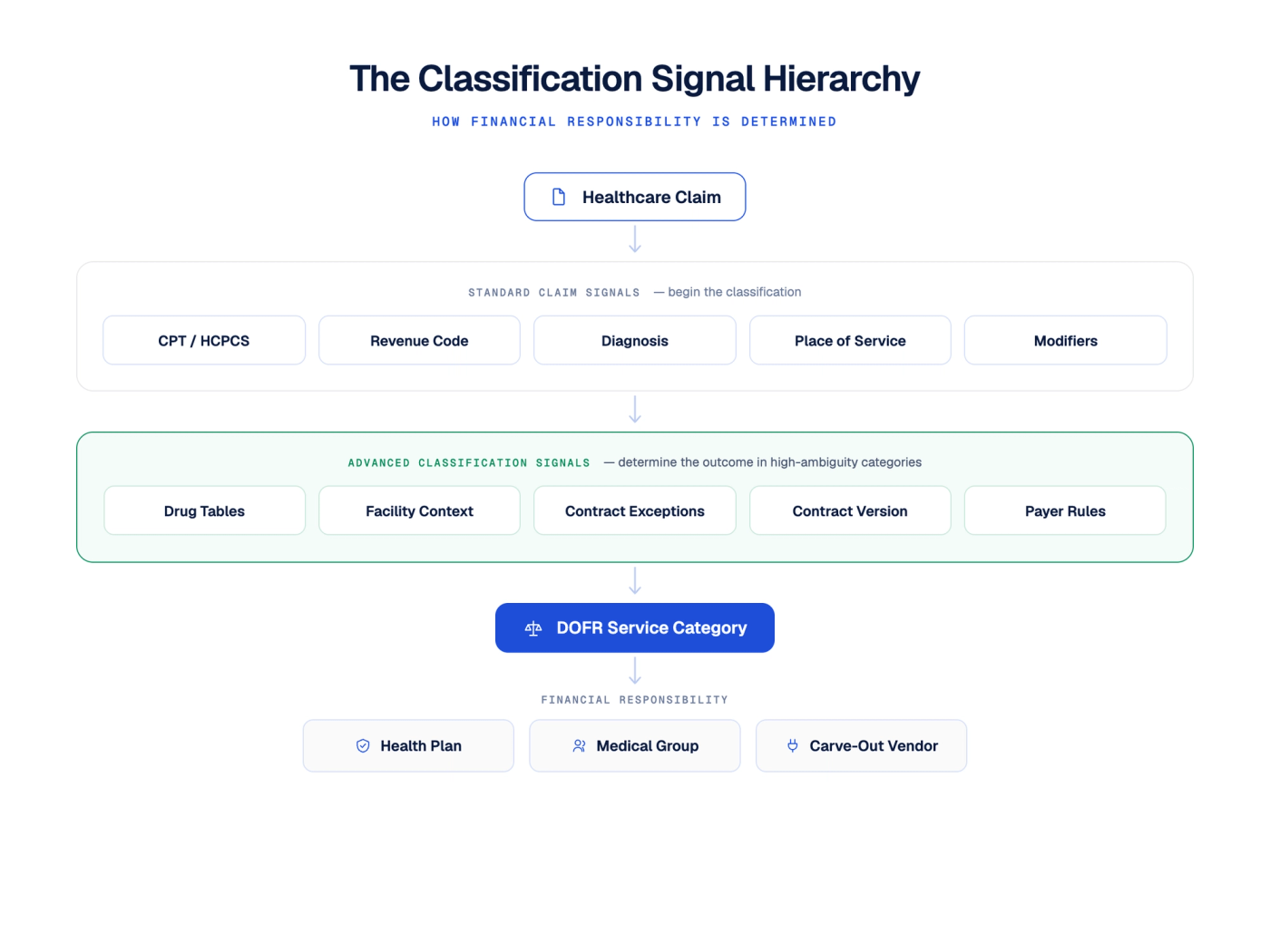
The Classification Signal Hierarchy
Every healthcare claim contains information that helps determine financial responsibility.
The challenge is that not all information carries the same weight.
Traditional claims adjudication relies primarily on a familiar set of claim attributes:
- CPT and HCPCS procedure codes
- Revenue codes
- Place of service
- Diagnosis codes
- Modifiers
For most healthcare claims, those signals are sufficient. They identify the appropriate service category, the member's benefits, and whether the claim should be paid.
DOFR classification often requires an additional layer of decision-making.
High-Ambiguity Categories depend on **classification signals** that exist outside the standard adjudication workflow. These signals are not hidden. They simply are not part of the traditional logic used to determine claim payment.
Examples include:
- Drug classification tables that distinguish chemotherapy agents from non-chemotherapy drugs
- Route of administration when the same medication can be delivered through multiple methods
- Contract-specific exception tables that override general service category rules
- Contract versions that change classification rules over time
- Payer-specific delegated risk provisions that differ across organizations
These advanced classification signals determine financial responsibility even when every traditional claim signal appears identical.
That distinction explains why many DOFR errors remain invisible during adjudication.
The claim is processed correctly.
The member is eligible.
The provider billed appropriately.
The payment is issued.
Only the financial owner is wrong.
Understanding this hierarchy is the key to understanding why a relatively small number of High-Ambiguity Categories generate a disproportionate share of DOFR misclassification errors.
________________________________________
________________________________________
High-Ambiguity Categories Driven by Drug Classification
Three of the six highest-risk High-Ambiguity Categories share the same underlying characteristic.
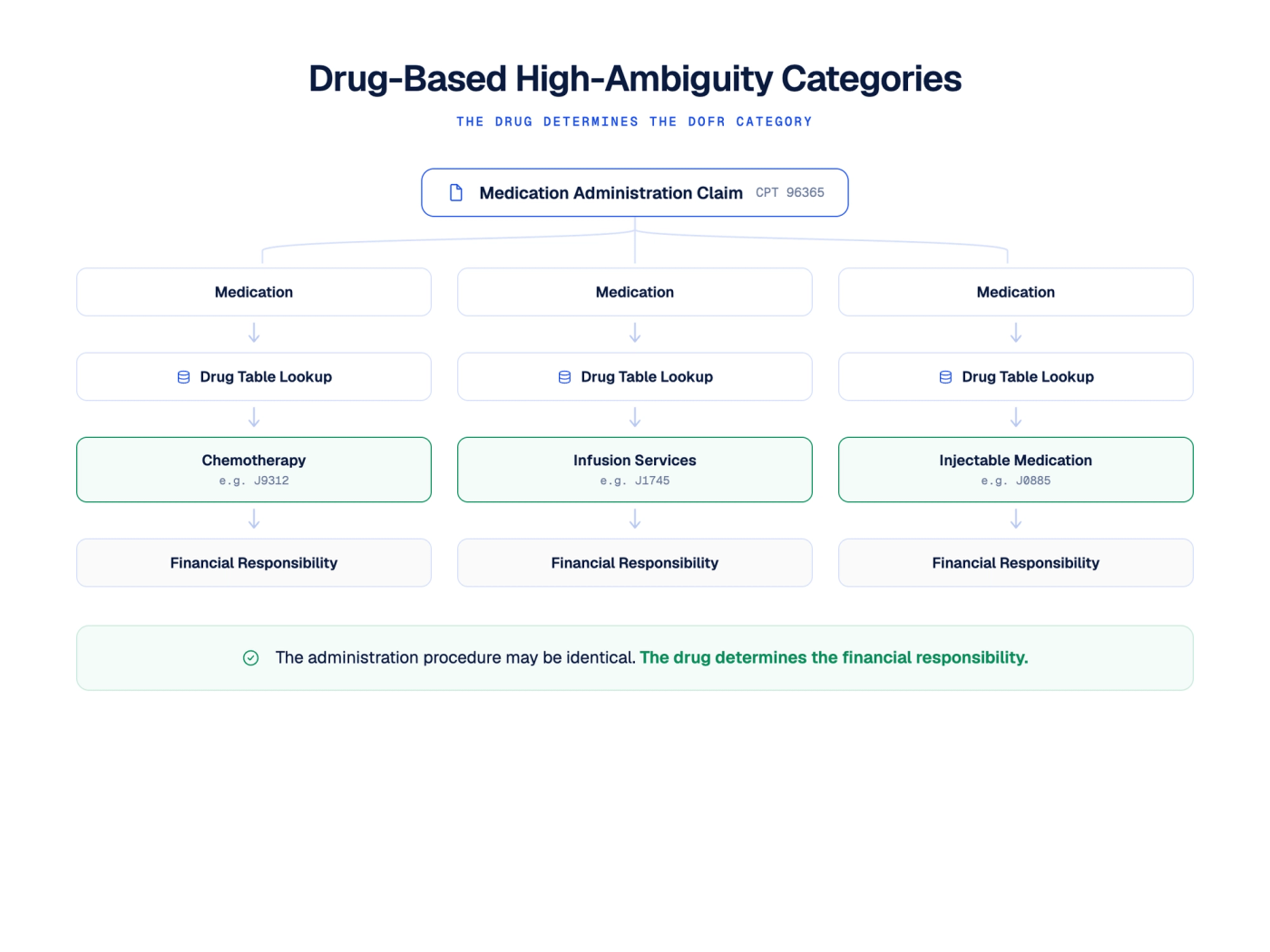
The administration of the medication looks nearly identical.
The financial responsibility does not.
This distinction surprises many people outside delegated risk because claims systems naturally emphasize the procedure that was performed. In these categories, however, the procedure is often the least important classification signal.
The medication itself determines the correct DOFR category.
A chemotherapy infusion and an iron infusion may both use the same administration CPT code. They may occur in the same infusion center, be performed by the same clinical staff, and generate nearly identical claims.
Financial responsibility changes because the drug changes.
This is one of the defining characteristics of High-Ambiguity Categories.
The decisive signal exists outside the administration code.
Instead, the claims examiner or classification engine must evaluate external reference information such as drug classification tables before assigning the correct DOFR category.
The following three category pairs all follow this pattern.
Although each has its own operational nuances, they share the same fundamental principle:
The drug determines the category, not the administration code.
High-Ambiguity Category 1
Chemotherapy vs. Infusion Services
This is arguably the highest financial risk category in delegated risk operations.
Chemotherapy drugs are among the most expensive services managed under a DOFR. Non-chemotherapy infusion drugs are also high-cost services, yet they are frequently assigned to different financially responsible parties.
Unfortunately, they often appear identical when viewed through the lens of traditional claims adjudication.
The administration CPT code may be 96413.
The revenue code may be identical.
The place of service may be identical.
Everything visible on the claim suggests the services belong to the same category.
They do not.
The determining signal is whether the administered drug appears on the payer's chemotherapy drug classification table. In many California delegated risk arrangements, this is the ICCOP Drug Table 1.
For example:
- J9035 (bevacizumab/Avastin) classifies as Chemotherapy because it appears on the chemotherapy drug table.
- J1756 (iron sucrose) classifies as Infusion Services because it does not.
Nothing about the administration changes.
Everything about financial responsibility changes.
Without evaluating the applicable drug table, a claims system cannot reliably distinguish between these services. The claim processes successfully, but the wrong organization may ultimately absorb the financial responsibility.
High-Ambiguity Category 2
Chemotherapy vs. Injectable Medication
The second High-Ambiguity Category follows the same decision pattern while introducing a different financial boundary.
Instead of distinguishing chemotherapy from infusion services, the classification engine must distinguish chemotherapy from injectable medications that are commonly delegated to the medical group.
Once again, the deciding signal is not the administration procedure.
It is the drug itself.
Chemotherapy agents remain classified as Chemotherapy regardless of how they are administered. Injectable medications follow their own drug classification rules, often referencing a separate payer-defined drug table.
Organizations that classify these claims based only on administration codes risk assigning expensive oncology drugs to capitated service categories that were never intended to absorb those costs.
Because oncology treatment is recurring, the financial impact compounds with every treatment cycle rather than appearing as a single isolated error.
High-Ambiguity Category 3
Infusion Services vs. Injectable Medication
The third drug-based High-Ambiguity Category is often less visible than oncology-related classifications, but it creates many of the same operational challenges.
Many medications can be delivered through either an infusion or an injection. While the clinical objective may be similar, the delegated financial responsibility may not be.
Once again, administration codes alone are insufficient.
An administration CPT code identifies how the medication was delivered, but it does not always identify the contractual service category.
Instead, classification depends on reference information such as:
- The billed HCPCS drug code
- Payer-maintained drug classification tables
- Contract-specific exception rules
- Applicable DOFR definitions
Without those additional classification signals, an injectable medication may be incorrectly assigned to an infusion category, or vice versa.
Because these services occur frequently across multiple specialties, even a small misclassification rate can generate a meaningful volume of wrong-party payments over time.
________________________________________
________________________________________
High-Ambiguity Categories Driven by Facility and Contract Context
Not every High-Ambiguity Category is determined by a drug table.
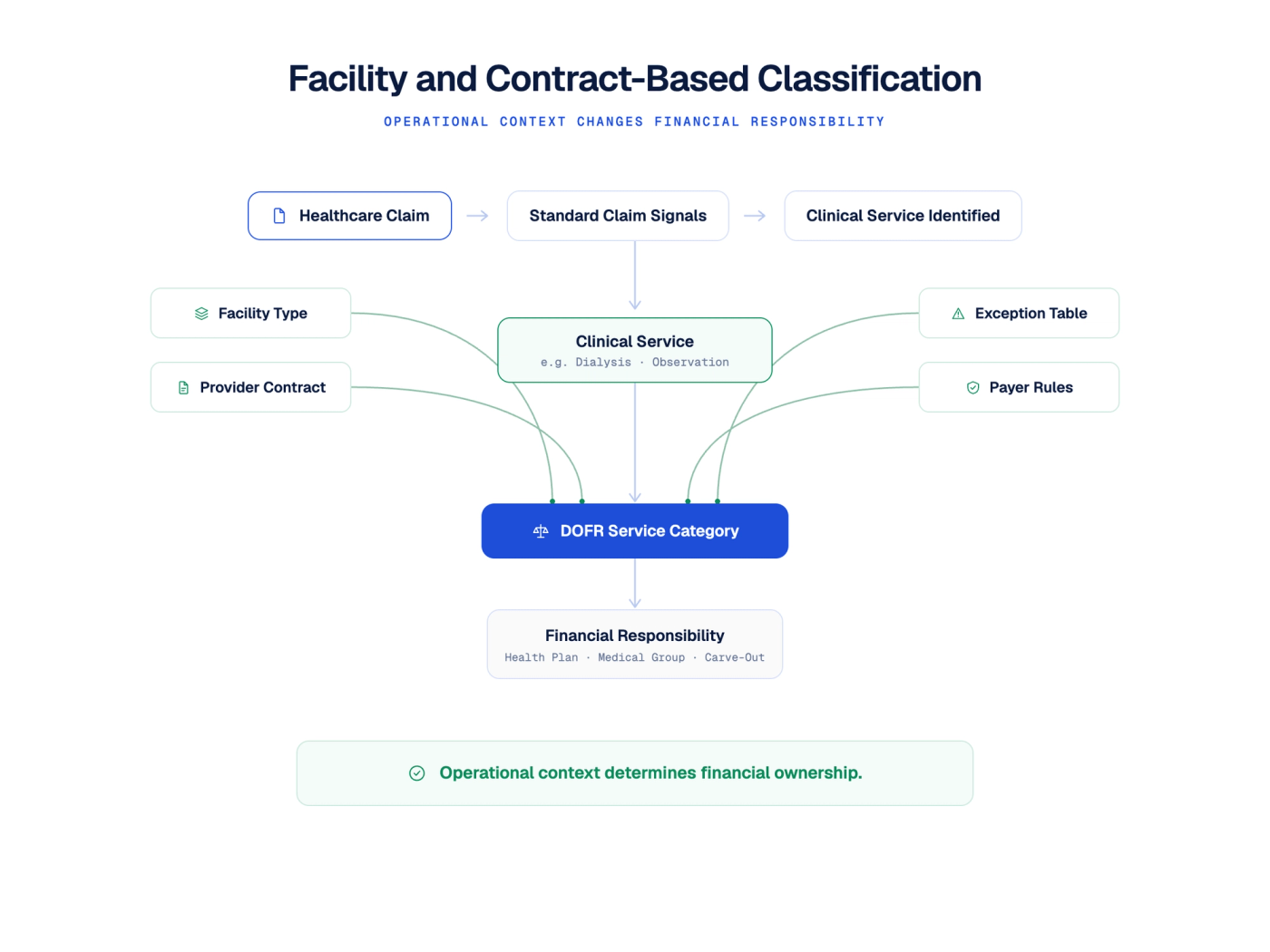
Some categories depend on where the service is performed, how the provider is contracted, or whether the payer has defined contractual exceptions that override the general classification rules.
These situations introduce a different type of ambiguity.
The procedure itself may be obvious.
The contractual ownership is not.
Unlike the drug-based categories, where classification depends primarily on the medication being administered, these categories depend on operational and contractual context surrounding the service.
Three category boundaries consistently create the greatest operational complexity.
High-Ambiguity Category 4
Diagnostic Services vs. Laboratory Services
Diagnostic and laboratory services frequently appear similar from a claims perspective.
Both involve testing.
Both may occur during the same episode of care.
Both often originate from outpatient facilities.
The distinction becomes important because delegated risk agreements commonly assign different financial responsibility to diagnostic imaging and laboratory testing.
Laboratory services generally involve analysis of biological specimens, while diagnostic services encompass imaging and other procedures that evaluate disease without laboratory analysis.
Although this distinction appears straightforward conceptually, operational classification often depends on combinations of:
- CPT and HCPCS codes
- Revenue codes
- Performing provider type
- Facility characteristics
- Contract-specific overrides
When classification logic relies too heavily on only one of these signals, claims may be routed to the wrong financial owner.
________________________________________
High-Ambiguity Category 5
Diagnostic Services vs. Endoscopy
Endoscopy presents another example where procedure codes alone may not fully determine financial responsibility.
Many delegated risk contracts establish separate treatment for endoscopic procedures because of differences in facility reimbursement, specialty carve-outs, or negotiated contractual provisions.
The procedure itself may appear to fit a broad diagnostic category.
The contract may define it differently.
As a result, organizations frequently maintain exception tables that redirect specific CPT codes away from the default diagnostic classification.
These exception tables are not corrections to the claims process.
They are an expected component of accurate DOFR implementation.
Without them, classification systems tend to overgeneralize, producing financially incorrect but technically valid claim assignments.
________________________________________
High-Ambiguity Category 6
Radiation Therapy vs. Diagnostic Radiology
Radiation-related services create one of the clearest examples of why clinical similarity does not always imply financial similarity.
Both involve imaging technologies.
Both are performed by radiology-related specialties.
Both may occur within the same facility.
Their financial responsibility is often completely different.
Diagnostic radiology focuses on imaging performed to identify or evaluate disease.
Radiation therapy delivers treatment.
Although the clinical distinction is well understood, operational classification frequently becomes more difficult because provider organizations, facilities, and billing practices vary across markets and payer contracts.
Successful classification therefore depends on integrating:
- Procedure codes
- Revenue codes
- Facility information
- Contract definitions
- Payer-specific exception rules
The more delegated risk relationships an organization manages, the more important these supplemental classification signals become.
________________________________________
________________________________________
Why Static Configuration Eventually Breaks Down
Many organizations begin delegated risk implementation with a straightforward configuration strategy.
Each CPT code is assigned to a single DOFR category.
For relatively simple service categories, that approach performs well.
Over time, however, new contracts, updated drug tables, payer amendments, and operational exceptions accumulate.
Classification logic becomes progressively more dependent on external reference data.
Static configuration struggles because it assumes that every claim can be categorized using the same limited set of claim attributes.
High-Ambiguity Categories demonstrate why that assumption eventually fails.
As delegated risk programs mature, organizations typically introduce additional layers of classification logic, including reference tables, exception management, contract versioning, and governance processes designed to keep financial responsibility aligned with changing contractual requirements.
The objective is not to make classification more complicated.
It is to make it more accurate.
Accurate financial responsibility depends on evaluating all of the signals that determine ownership, not just the signals that determine payment.
Operational Implications
High-Ambiguity Categories are more than an academic classification challenge. They have measurable operational, financial, and provider relationship consequences across delegated risk organizations.
When financial responsibility is assigned incorrectly, the effects often extend well beyond a single claim.
Financial Leakage
Wrong-party payments distort capitation performance, utilization reporting, and medical expense accounting.
Because the claim adjudicates successfully, these errors frequently remain undetected until financial reconciliation or contract settlement, when recovering funds may require manual investigation and inter-organizational adjustments.
Provider Abrasion
Providers generally expect consistent payment regardless of the contractual complexity behind the scenes.
When claims are repeatedly redirected between financially responsible organizations, providers experience delayed payment, inconsistent explanations, and additional administrative work.
Over time, these experiences contribute to provider abrasion, increasing frustration while reducing confidence in delegated payment processes.
Operational Burden
Claims operations teams often become the final checkpoint for classification issues that originate much earlier in the workflow.
Manual reviews, exception handling, retroactive adjustments, and reconciliation efforts consume resources that could otherwise support higher-value operational improvements.
Organizations managing multiple delegated contracts frequently maintain extensive reference tables simply to preserve classification accuracy as contractual rules evolve.
Governance Challenges
High-Ambiguity Categories demonstrate why DOFR governance cannot rely solely on static configuration.
Effective governance requires continuous maintenance of:
- Drug classification tables
- Contract-specific exception rules
- Version-controlled configuration
- Classification testing
- Financial reconciliation processes
The objective is not to eliminate complexity.
The objective is to ensure that contractual responsibility remains aligned with changing payer agreements over time.
________________________________________
Bottom Line
Most DOFR service categories are straightforward to classify because standard claims data provides sufficient information to determine financial responsibility.
High-Ambiguity Categories are different.
In these situations, the correct financial owner depends on classification signals that extend beyond traditional adjudication data, including drug reference tables, contractual exceptions, facility context, and payer-specific business rules.
The six category boundaries discussed in this article consistently generate operational risk because they expose the limits of static claims classification.
Organizations that recognize these boundaries and incorporate advanced classification signals into their governance processes are better positioned to reduce wrong-party payments, improve reconciliation accuracy, and maintain consistent financial responsibility across evolving delegated risk contracts.
Ultimately, accurate DOFR classification is not simply a claims processing function.
It is a financial governance capability.
________________________________________
Key Takeaways
- Most DOFR categories can be classified using standard claims signals.
- High-Ambiguity Categories require additional classification signals beyond the claim itself.
- Drug classification tables often determine financial responsibility more accurately than administration procedure codes.
- Facility characteristics and contractual exception rules introduce another layer of classification complexity.
- Successful delegated risk operations depend on continuously maintaining the reference data that supports accurate financial responsibility assignment.
________________________________________
Frequently Asked Questions
What makes a service category "high ambiguity"?
A High-Ambiguity Category is one in which standard claims information does not reliably identify the correct DOFR category. Additional classification signals, such as drug tables, facility context, or contractual exception rules, are required to determine financial responsibility accurately.
________________________________________
Why aren't CPT codes alone sufficient?
CPT codes describe the clinical service performed, but delegated financial responsibility is defined by contracts rather than procedure codes alone. Multiple contractual service categories may legitimately share similar billing characteristics while assigning financial responsibility differently.
________________________________________
Why do these errors often go unnoticed?
Most misclassification errors do not prevent a claim from adjudicating successfully.
Eligibility is verified.
Benefits are applied correctly.
The provider is paid.
The error is that payment is assigned to the wrong financially responsible organization, which often becomes visible only during reconciliation.
________________________________________
Are these six category boundaries the only ones that create problems?
No.
These six boundaries consistently generate a disproportionate share of operational complexity because they depend on additional classification signals. Other categories may also require specialized rules depending on the payer, delegated agreement, or local market.
________________________________________
How can delegated risk organizations reduce misclassification errors?
Organizations typically improve accuracy by combining standard claims data with well-governed reference information, including drug classification tables, contract-specific exception rules, version-controlled configuration, testing processes, and ongoing financial reconciliation.
________________________________________
Continue Learning
If you found this article helpful, continue with these related guides:
- Understanding Division of Financial Responsibility (DOFR) Agreements
- The Three-Way Model of Financial Responsibility
- Wrong-Party Payments in Delegated Risk
- Provider Abrasion: The Hidden Cost of Financial Responsibility Errors