Why Static DOFR Configuration Eventually Fails
Static claims configuration works only as long as the underlying DOFR contract remains unchanged. This article introduces Configuration Drift, explains why quarterly amendments inevitably cause configuration to diverge from contract terms over time, and explores the operational risks that result.

Executive Summary
Most delegated risk organizations begin DOFR implementation with a reasonable approach.
Each service category in the DOFR matrix is translated into system configuration rules. CPT codes are mapped to categories. Revenue codes are assigned to financially responsible parties. The claims adjudication platform is configured to route financial responsibility automatically based on these rules.
For the first few months, this works.
The DOFR document matches the system configuration. Claims are processed according to the current contract terms. Financial responsibility is assigned correctly.
Then the first quarterly amendment arrives.
New drug codes enter the market. A biosimilar replaces an existing biologic on the drug classification table. The health plan reclassifies a group of CPT codes from one service category to another. An exception table adds procedures that now route differently than the general classification rules would suggest.
Each change is individually manageable.
The challenge is that the changes never stop.
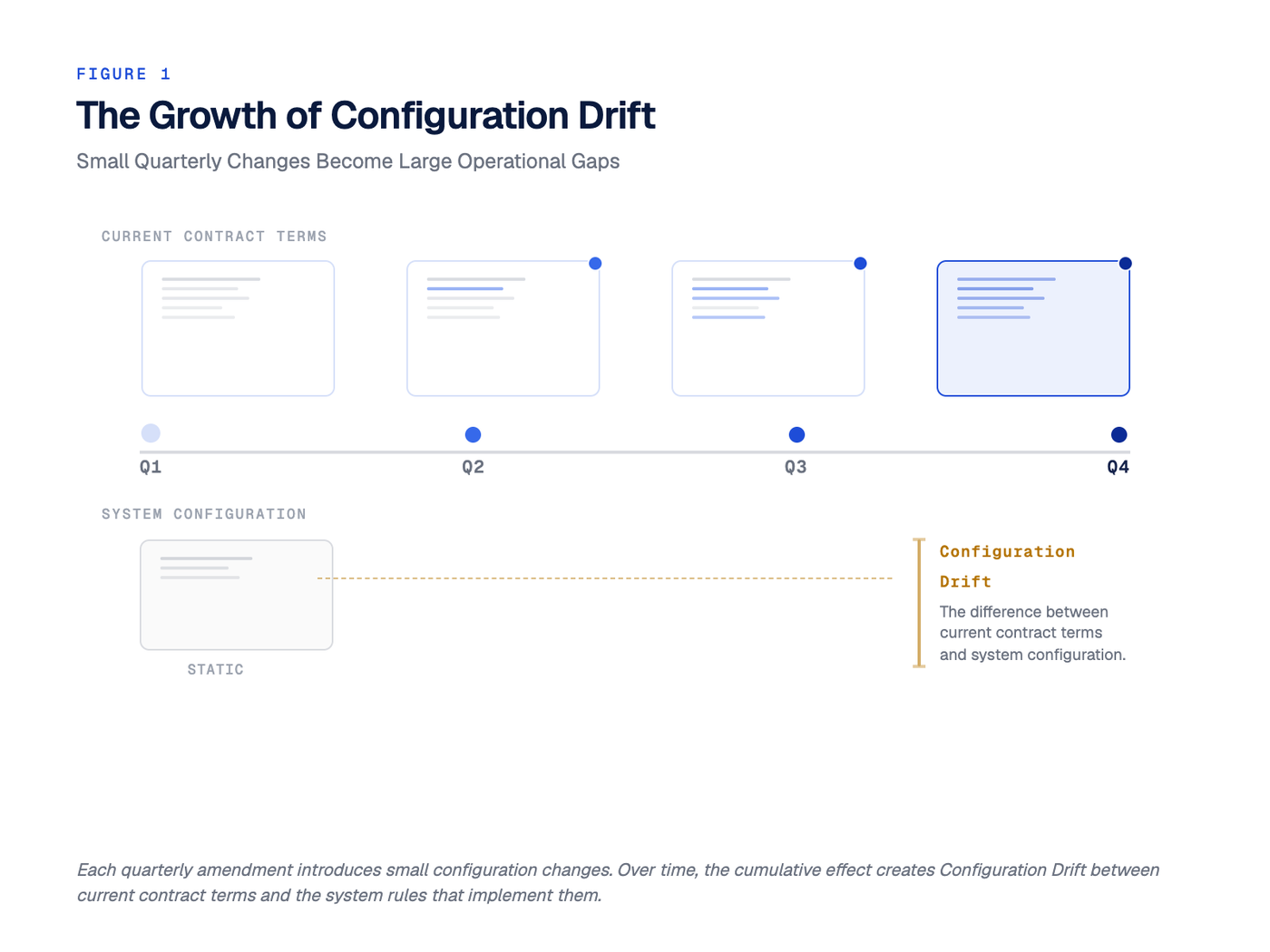
Over time, a gap opens between what the DOFR contract requires and what the claims system is configured to do.
That gap is Configuration Drift: the progressive divergence between current contract terms and the system rules that implement them.
Configuration Drift does not announce itself. It does not generate denials or trigger system alerts. Claims continue to adjudicate successfully. Payments continue to flow. The divergence becomes visible only when financial reconciliation reveals that the wrong party has been absorbing costs, sometimes for months.
Understanding why Configuration Drift is inevitable, rather than merely possible, is essential for any organization operating under delegated risk agreements.
Key Concepts
Configuration Drift
The progressive divergence between a DOFR's current contract terms and the system configuration rules that implement those terms. Configuration Drift is driven by quarterly amendments, drug table updates, exception table changes, and the cumulative effect of managing these changes across multiple payer contracts simultaneously.
Amendment Cycle
The recurring process through which health plans issue formal changes to DOFR schedules. Most major California health plans issue amendments quarterly, though mid-quarter updates can occur in response to regulatory mandates, new drug launches, or benefit design changes.
Configuration Surface Area
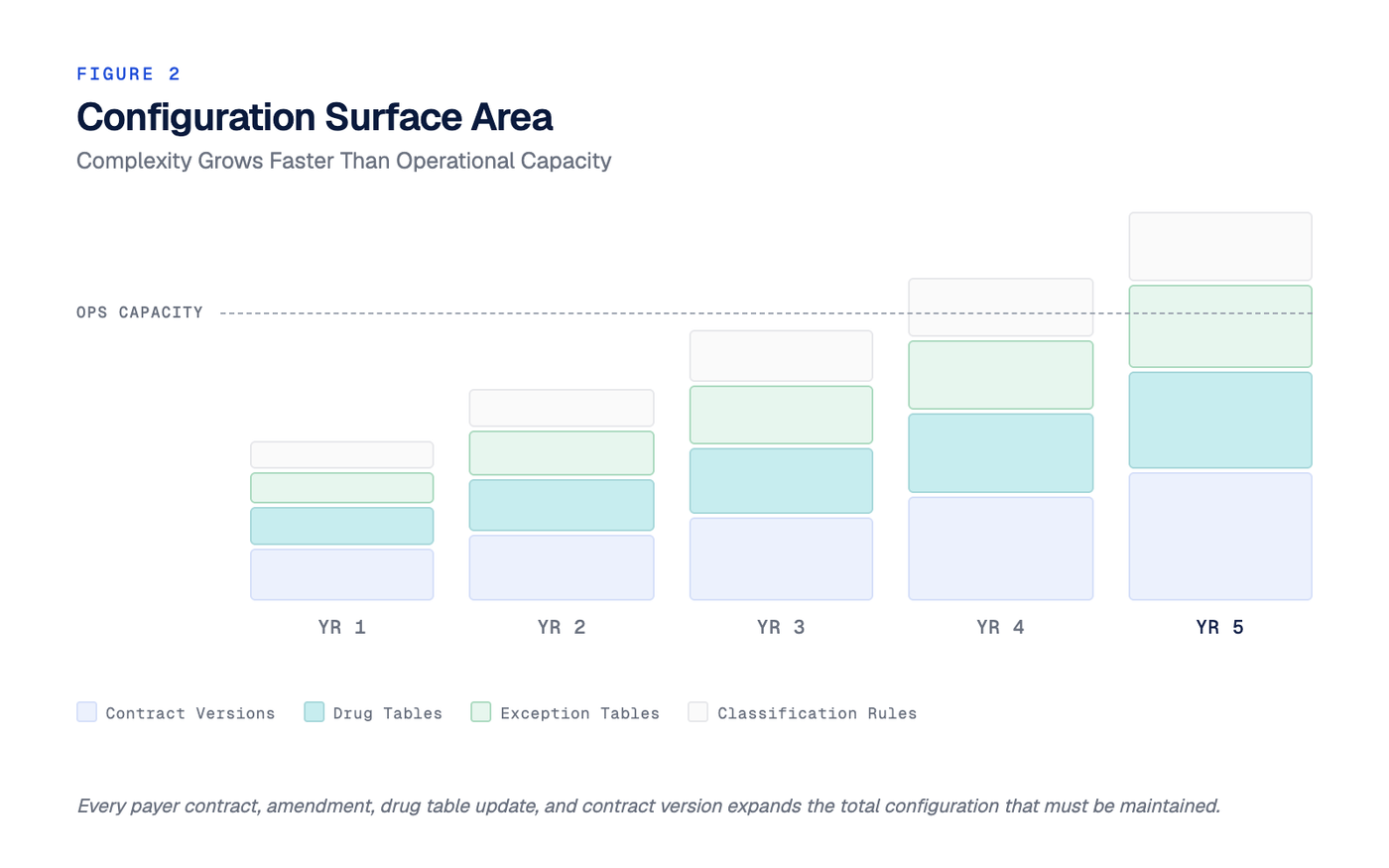
The total number of independent classification rules, drug table entries, exception table overrides, and contract-version-specific settings that an organization must maintain to preserve accurate financial responsibility. Every new payer contract and every amendment increases Configuration Surface Area. It rarely decreases.
Contract Version
A specific amendment of a DOFR schedule with defined effective and termination dates. A single payer relationship may accumulate multiple contract versions over time, each governing claims within its effective date range. Applying the wrong version to a claim can produce a wrong-party payment even when the underlying configuration is otherwise correct.
How DOFR Configuration Begins
To understand why static configuration eventually fails, it helps to understand how it begins.
When a delegated risk organization enters a new contract with a health plan, the DOFR schedule is a well-defined document. It lists every service category. It specifies the financially responsible party for each category. It identifies carved-out services and the third-party payers that manage them.
The organization's claims operations team translates this document into system configuration. In platforms such as QNXT, HealthEdge, or Facets, each service category becomes a set of rules describing which services belong to each category and which organization bears financial responsibility.
The initial configuration is usually accurate.
The problems begin when the contract starts to change.
The Quarterly Amendment Cycle
DOFRs are not static documents.
They evolve continuously.
New medications enter the market. Biosimilars change drug classification tables. CMS issues regulatory updates. Health plans revise service classifications, benefit structures, or delegation terms.
Each of these events can trigger a DOFR amendment.
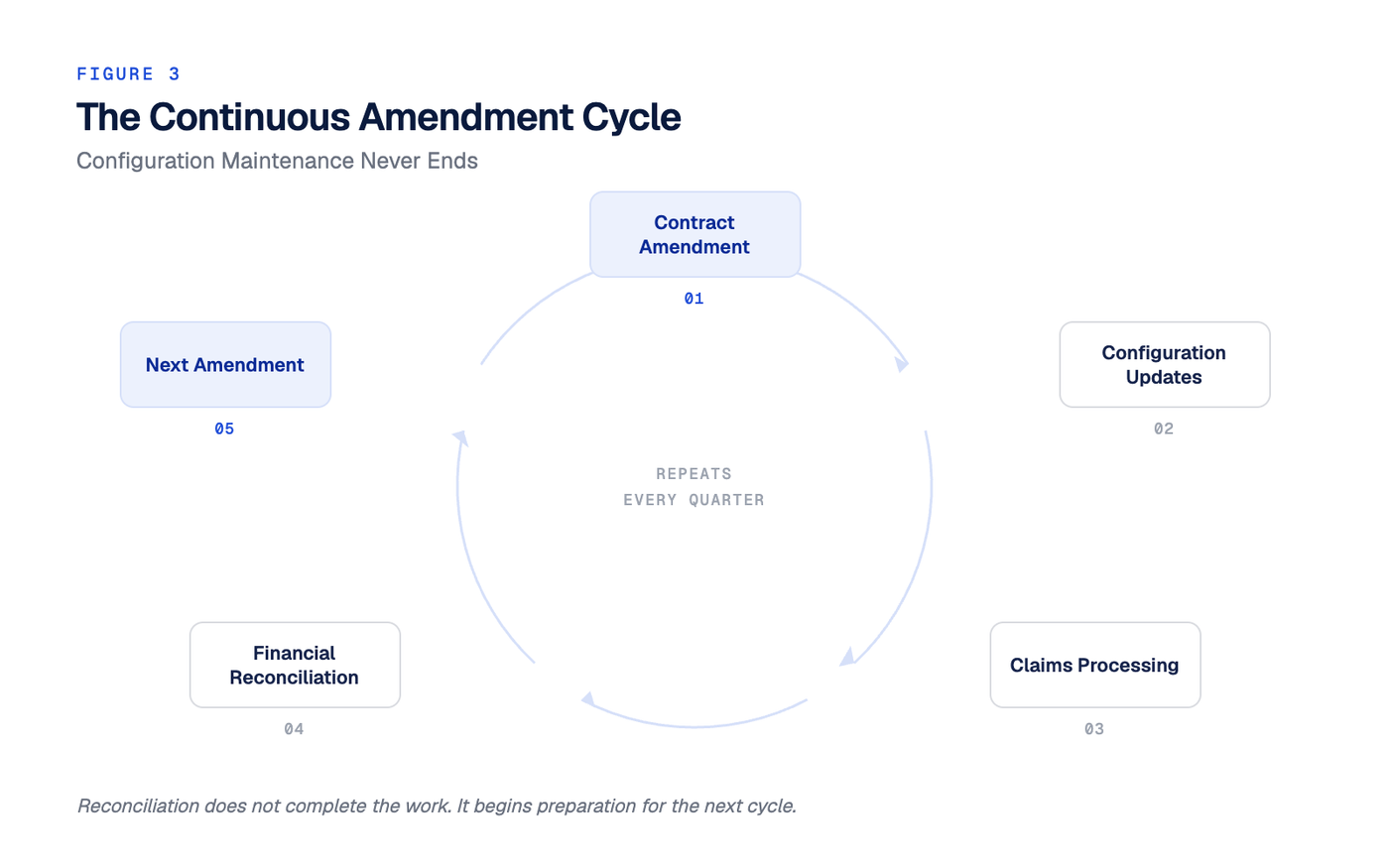
One payer relationship may generate four quarterly amendments each year. Most delegated risk organizations manage many payer relationships simultaneously, each with its own amendment schedule.
The operational workload is not a handful of changes.
It is dozens, sometimes hundreds, of configuration updates distributed across every contract.
Every amendment increases the likelihood that configuration and contract begin to diverge.
Drug Table Updates
Drug classification tables are among the most frequent and financially significant sources of DOFR change.
New biologics, biosimilars, and generic launches routinely require payers to revise drug classification tables.
Each revision changes how financial responsibility is determined for affected medications.
Every update requires corresponding changes within the claims configuration.
Drug codes must be added, removed, reclassified, tested, and validated against the updated contract terms.
If even one update is missed, claims continue processing successfully while financial responsibility silently shifts to the wrong organization.
Exception Table Changes
Exception tables introduce complexity beyond standard classification rules.
Drug tables determine responsibility based on the medication.
Exception tables override general classification rules based on specific procedures or contractual provisions.
A hospital outpatient procedure may normally belong to one DOFR category while a handful of CPT codes are intentionally routed elsewhere.
These are negotiated contractual decisions.
They change regularly.
Each amendment can modify both the general rules and the exceptions, requiring operations teams to understand not only the individual changes but how they interact.
Contract Version Management
Every amendment creates another contract version.
Each version governs claims within specific effective dates.
Claims must be processed according to the contract version in effect on the date of service, not the date the claim is processed.
Applying the wrong contract version changes financial responsibility even when every configuration rule is technically functioning as designed.
Partial amendments create additional complexity because only portions of previous agreements are superseded.
Version management therefore introduces a temporal dimension to DOFR configuration that is often underestimated.
The Compounding Effect
Quarterly amendments.
Drug table updates.
Exception table changes.
Contract version management.
Each of these is manageable on its own.
The challenge is that they occur simultaneously, across every payer contract, every quarter, indefinitely.
This continual accumulation creates Configuration Surface Area.
Every new payer relationship introduces more classification rules.
Every amendment adds more exceptions.
Every contract version adds another layer of historical logic.
Nothing in the normal operating cycle reduces this complexity.
Over time, organizations are asked to maintain an ever-growing body of configuration with finite operational resources.
Configuration Drift is not caused by one missed update.
It emerges naturally as Configuration Surface Area expands faster than organizations can confidently maintain it.
Why Reconciliation Is Not a Solution
Many organizations rely on periodic financial reconciliation to identify configuration issues.
Reconciliation is valuable.
But it is not prevention.
By the time reconciliation identifies a discrepancy, every affected claim has already been adjudicated and paid.
Financial exposure has already accumulated.
The reconciliation process confirms that Configuration Drift has occurred.
It does not prevent the next occurrence.
Operational Implications
Financial Exposure Accumulates Silently
Configuration Drift rarely produces operational signals.
Claims adjudicate successfully.
Providers are paid.
The wrong organization's ledger gradually absorbs financial responsibility until reconciliation identifies the discrepancy.
Governance Becomes Increasingly Difficult
As Configuration Surface Area grows, verifying every configuration rule against every active contract becomes progressively more difficult.
Processes that worked when managing five payer contracts often fail to scale to fifteen.
Staff Turnover Multiplies Operational Risk
Configuration accuracy depends heavily on institutional knowledge.
When experienced configuration analysts leave, the rationale behind hundreds of implementation decisions often leaves with them.
Successive teams inherit increasingly complex configurations with progressively less understanding of why specific rules exist.
Each amendment then introduces additional opportunities for subtle divergence.
Provider Abrasion Increases
Configuration Drift eventually reaches providers.
Payment inconsistencies.
Retroactive adjustments.
Unexpected financial responsibility changes.
Collectively these create Provider Abrasion, the cumulative operational friction that erodes provider confidence in delegated payment processes.
Bottom Line
Static configuration works when contracts remain stable.
DOFR contracts do not.
Quarterly amendments, drug table updates, exception table revisions, and contract version changes continuously reshape financial responsibility.
Configuration Drift is therefore not an operational failure.
It is the predictable result of applying a static configuration approach to a continuously changing contractual environment.
The challenge is not building an accurate configuration.
The challenge is sustaining one.
Organizations that recognize Configuration Drift as an inevitable operational reality are better positioned to design governance processes, verification systems, and operational workflows that maintain long-term alignment between contract terms and system configuration.