Configuration Debt in Delegated Risk Operations
Configuration Debt is the hidden operational burden of undocumented rules, obsolete overrides, and inherited claims configuration. Learn how it increases DOFR error risk, compounds over time, and why reducing it strengthens delegated risk governance.

Executive Introduction
Every delegated risk organization carries debt.
Not financial debt.
Configuration Debt.
It does not appear on a balance sheet.
It accumulates quietly inside claims configuration.
Undocumented overrides.
Exception tables.
Legacy business rules.
Inherited assumptions.
Institutional knowledge.
Most organizations never notice it accumulating because the claims system continues working.
Claims adjudicate successfully.
Providers receive payment.
Quarterly amendments are implemented.
Operations appear healthy.
Yet every undocumented rule makes the next contract amendment harder to implement safely.
Every obsolete override increases the probability of future error.
Every undocumented assumption raises the cost of maintaining contractual accuracy.
Software engineers have a name for this phenomenon: technical debt.
Technical debt describes what happens when expedient implementation decisions accumulate over time. The software still works, but modifying it becomes progressively harder, slower, and more likely to introduce defects.
Delegated risk organizations face the same dynamic.
Not in software.
In configuration.
Configuration Debt is the accumulated burden of undocumented rules, obsolete overrides, inherited configurations, and institutional knowledge dependencies that increase the probability of DOFR errors with every amendment cycle.
Unlike Configuration Drift, which describes active divergence between contract terms and operational rules, Configuration Debt describes the structural conditions that make that divergence increasingly likely.
Configuration Drift is the symptom.
Configuration Debt is one of its underlying causes.
Understanding the distinction matters because the solutions are different.
Configuration Drift requires verification.
Configuration Debt requires remediation.
Organizations that understand both are far better positioned to maintain accurate financial responsibility as delegated arrangements continue to evolve.
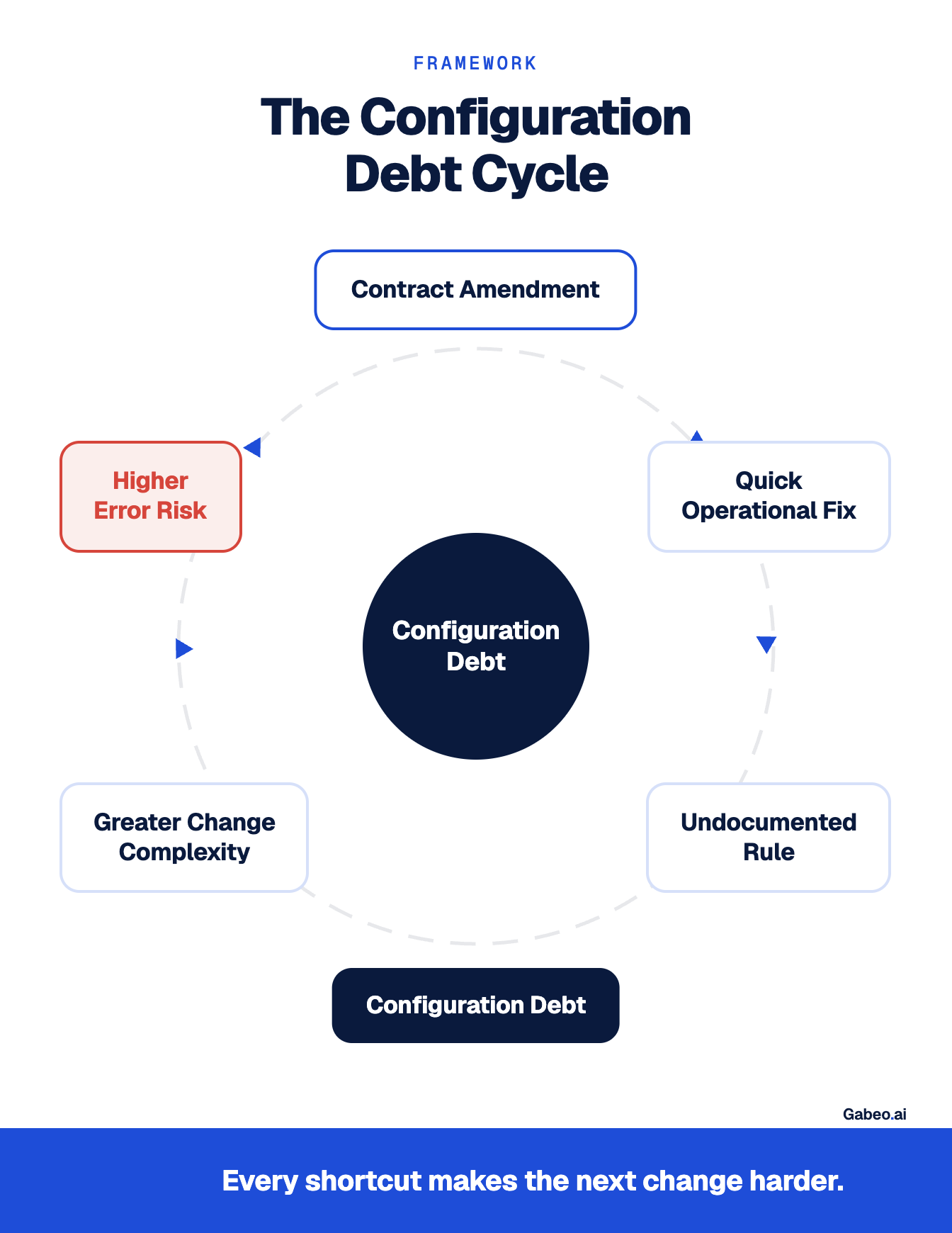
What Configuration Debt Looks Like in Practice
Configuration Debt rarely appears all at once.
It accumulates through hundreds of individually reasonable operational decisions made over months and years.
Each decision solves an immediate problem.
Together, they create an environment where every future change becomes more difficult.
Consider a familiar example.
A claims examiner adds a CPT override during a contract dispute.
The dispute is eventually resolved.
The override remains.
Nobody documents why it was added.
Nobody knows whether removing it will affect another payer, another provider group, or another service category.
Leaving it in place feels safer than removing it.
The organization moves on.
Now imagine a quarterly amendment changes financial responsibility for injectable medications administered in outpatient settings.
The configuration team updates the primary drug table correctly.
But a secondary exception table, maintained by another analyst years earlier, still references the previous classification logic.
Most claims continue processing correctly.
Occasionally the two rule sets conflict.
The claims platform applies whichever rule it encounters first.
No operational alert appears.
Only reconciliation months later reveals that financial responsibility was assigned incorrectly.
Or consider a claims platform migration.
Thousands of DOFR configuration rules are translated from one adjudication platform to another.
Most migrate successfully.
Some require manual interpretation because equivalent functionality does not exist in the new platform.
Those implementation decisions become part of the new configuration.
At the time, they accurately reflect the team's understanding of the contract.
Years later, they become undocumented assumptions embedded within production.
No individual decision appears unreasonable.
Each was made under real operational constraints.
Each solved a legitimate business problem.
Each added a small amount of Configuration Debt.
Eventually, routine quarterly amendments become increasingly difficult—not because contracts have become dramatically more complicated, but because the configuration environment has.
Configuration Debt rarely becomes visible during routine operations. It becomes visible during change.
Configuration Debt often reveals itself during moments that require organizations to adapt.
A new payer contract.
A benefit redesign.
A platform migration.
A staffing transition.
A regulatory update.
An audit.
The operational challenge is rarely the change itself.
It is understanding how that change interacts with years of accumulated configuration decisions.
That accumulated complexity is what organizations must ultimately manage.
The Five Sources of Configuration Debt
Configuration Debt rarely originates from a single mistake.
It accumulates through predictable operational patterns that exist in nearly every delegated risk organization.
While the specific configuration differs across health plans, delegated entities, and claims platforms, the underlying sources of debt are remarkably consistent.
Understanding these sources helps organizations recognize where Configuration Debt is likely accumulating long before it begins affecting financial responsibility.
1. Undocumented Overrides
Every claims adjudication platform allows exceptions to standard classification rules.
Those exceptions are often necessary.
A payer contract may assign financial responsibility differently for a specific CPT code.
A provider type may require unique handling.
A temporary amendment may apply only during a defined period.
Overrides make these exceptions operationally possible.
The problem is rarely the override itself.
The problem begins when the override outlives the documentation explaining why it exists.
Months later, another analyst discovers the rule.
The configuration still functions.
No one remembers the business reason behind it.
Removing the override feels risky.
Keeping it feels safer.
The rule remains.
Configuration Debt increases.
2. Obsolete Rules
Healthcare contracts evolve continuously.
Benefit designs change.
Service categories move between capitation and plan risk.
Carve-outs are introduced.
Older amendments are replaced.
Every contractual change should retire the configuration rules implementing the previous agreement.
In practice, that rarely happens.
Removing configuration feels inherently riskier than adding new configuration.
Organizations often leave the previous rule in place while introducing another rule beside it.
The claims system continues operating.
The configuration becomes progressively more difficult to understand.
Every obsolete rule expands the operational surface area that future analysts must navigate.
3. Inherited Configuration
Few delegated organizations begin with a completely clean configuration environment.
Claims platforms are upgraded.
Medical groups merge.
IPAs acquire other organizations.
Health plans migrate between adjudication systems.
Configuration accompanies every transition.
Inherited rules may have been entirely appropriate when originally implemented.
Years later, they become assumptions embedded within a new operational environment.
The current team inherits not only the configuration itself, but also every undocumented decision made by the previous team.
Each inherited assumption becomes another layer of Configuration Debt.
4. Institutional Knowledge
Some of the most important configuration knowledge never exists in documentation.
It exists in people.
Experienced configuration analysts know which exception tables remain active.
They remember why a specific override was introduced during a contract negotiation.
They understand which drug classifications require manual review because automated logic produces inconsistent results.
That expertise keeps operations running smoothly.
It also creates operational risk.
When knowledge exists primarily in the minds of a small number of individuals, staff transitions become configuration events.
The rules remain.
The understanding behind those rules does not.
Institutional knowledge is one of the largest—and least visible—sources of Configuration Debt.
5. Deferred Documentation
Configuration changes often occur under significant time pressure.
Quarterly amendments arrive.
Regulatory updates become effective.
New contracts must be implemented before production deadlines.
The operational priority is correctly updating configuration.
Documentation frequently becomes secondary.
The team plans to complete it later.
Later rarely comes.
Quarter after quarter, documentation falls slightly behind implementation.
Eventually the gap between what the system actually does and what the documentation describes becomes substantial.
That gap is Configuration Debt.
Configuration Debt is not created by poor decisions. It is created by reasonable decisions made under operational pressure without sufficient long-term maintenance.
Why Configuration Debt Compounds
Software engineering offers a useful analogy.
Technical debt compounds because accumulated complexity makes every future change more difficult.
As changes become harder, organizations take shortcuts.
Those shortcuts create additional debt.
The cycle repeats.
Configuration Debt follows the same pattern.
Every undocumented override increases the effort required to evaluate future amendments.
Every obsolete rule introduces another dependency that must be considered before configuration changes are deployed.
Every inherited assumption reduces confidence that modifications can be implemented safely.
Every undocumented decision forces future analysts to reconstruct context that should already exist.
Over time, configuration becomes increasingly expensive to change.
Organizations respond by making the smallest possible modifications rather than improving the overall configuration environment.
That decision solves today's problem.
It also increases tomorrow's complexity.
The cycle accelerates.
Configuration Debt therefore compounds in much the same way financial debt compounds through interest.
The longer debt remains unmanaged, the greater the effort required to reduce it.
Configuration Debt Usually Appears During Change
Organizations rarely discover Configuration Debt during routine operations.
Routine claims processing may continue for years without obvious operational disruption.
Configuration Debt becomes visible when organizations attempt to change something.
Three situations consistently expose accumulated debt.
Staff Transitions
When experienced analysts leave, organizations quickly discover how much operational knowledge was never documented.
The replacement understands what the configuration does.
Understanding why it behaves that way becomes considerably more difficult.
Platform Migrations
Claims platform migrations force organizations to translate years of operational knowledge into explicit configuration.
Rules that once depended upon institutional memory must suddenly be documented.
Migration projects often reveal configuration complexity that had remained hidden for years.
Audit Responses
Auditors increasingly expect delegated organizations to explain how financial responsibility rules are implemented.
A configuration may consistently produce correct results.
Explaining why those results occur can become surprisingly difficult when years of overrides, inherited assumptions, and undocumented changes have accumulated.
Configuration Debt transforms operational confidence into operational uncertainty.
Configuration Debt rarely interrupts today's claims processing.
It complicates tomorrow's operational change.
That distinction explains why many organizations underestimate its significance until the accumulated complexity becomes impossible to ignore.
Configuration Debt and Configuration Drift
Configuration Debt and Configuration Drift are closely related.
They are not the same thing.
Understanding the distinction is essential because each describes a different operational problem and requires a different response.
Configuration Drift measures the gap between contractual intent and operational reality.
It answers a straightforward question:
Do the rules currently operating in the claims system still reflect the contract?
That question can be answered through verification.
Configuration is compared against current contract language.
Discrepancies are identified.
Corrections are made.
Configuration Drift is therefore observable.
It is measurable.
It can be reduced through systematic verification.
Configuration Debt addresses a different question.
How likely is this organization to introduce future configuration errors?
Rather than measuring today's accuracy, Configuration Debt measures the operational environment that determines whether tomorrow's changes can be implemented safely.
Organizations with minimal Configuration Debt can implement quarterly amendments confidently.
Their configuration is documented.
Dependencies are understood.
Override rules are traceable.
Knowledge is broadly distributed across the team.
Configuration changes remain manageable because the operational environment supports change.
Organizations carrying significant Configuration Debt face a very different reality.
Every amendment requires navigating undocumented overrides.
Legacy exception tables interact in unexpected ways.
Inherited assumptions complicate implementation.
Critical knowledge resides with a handful of experienced analysts.
The same contract amendment now requires considerably more effort and carries substantially greater operational risk.
Configuration Drift is therefore not inevitable.
But Configuration Debt steadily increases the probability that drift will occur.
One describes the observable condition.
The other describes the conditions that produce it.
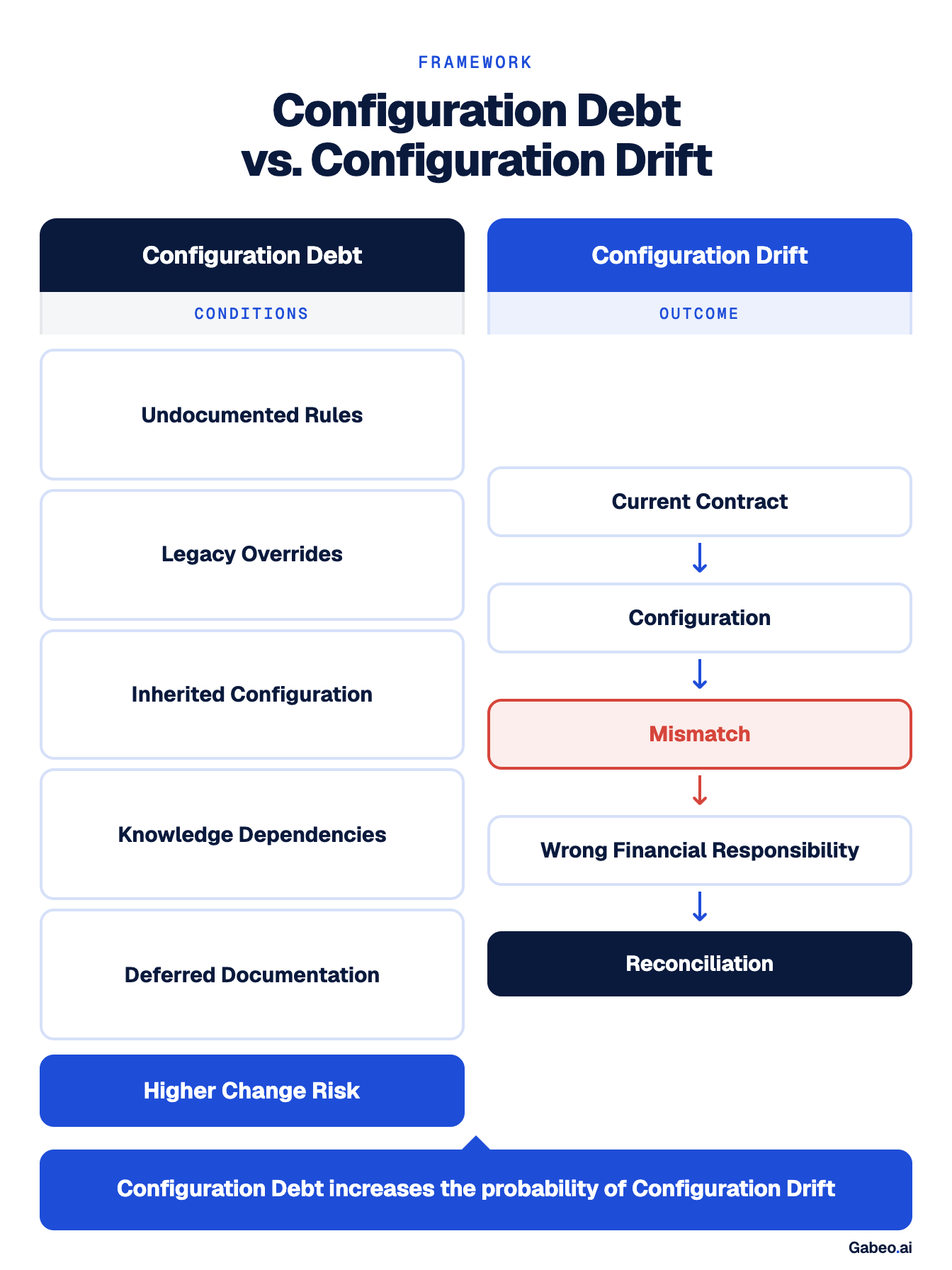
Configuration Drift tells you whether configuration is accurate today. Configuration Debt tells you how difficult it will be to keep it accurate tomorrow.
Configuration Fidelity provides the desired operational state.
It represents the condition where operational rules faithfully implement current contractual financial responsibility.
Maintaining Configuration Fidelity requires both ongoing verification and disciplined management of Configuration Debt.
Verification identifies inaccuracies.
Debt reduction lowers the probability that new inaccuracies will emerge.
Organizations need both.
Measuring Configuration Debt
Unlike Configuration Drift, Configuration Debt cannot be measured through a simple comparison against contract language.
It is an operational characteristic rather than a point-in-time condition.
Fortunately, organizations do not need a single Configuration Debt score to understand whether debt is increasing.
Several practical indicators provide meaningful visibility.
Override Density
Measure the proportion of override and exception rules relative to standard classification rules.
A growing concentration of overrides often indicates that operational complexity is increasing faster than configuration is being simplified.
Not every override represents debt.
An increasing dependence on overrides often does.
Documentation Coverage
Determine how many active configuration rules include documentation explaining:
- Why the rule exists.
- Which contract or amendment it implements.
- Who approved it.
- When it should be reviewed.
Organizations with high documentation coverage depend less on institutional memory and can implement future changes more confidently.
Amendment Implementation Time
Track the average time required to implement quarterly contract amendments.
Longer implementation cycles frequently indicate growing configuration complexity rather than growing contractual complexity.
When every amendment requires navigating years of accumulated configuration decisions, implementation naturally slows.
Post-Amendment Error Rate
Review reconciliation discrepancies that originate from recently implemented configuration changes.
Increasing error rates following amendment cycles often indicate that the configuration environment is becoming progressively harder to modify safely.
The issue may not be the amendment itself.
It may be the accumulated Configuration Debt surrounding it.
Knowledge Concentration
Identify configuration domains where only one individual fully understands the operational rules.
Every single-point knowledge dependency represents operational risk.
Organizations become significantly more resilient when critical configuration knowledge is documented, shared, and routinely reviewed.
None of these indicators independently measures Configuration Debt.
Together, however, they provide a practical picture of whether operational complexity is increasing or being actively reduced.
Organizations do not need perfect measurement.
They need trend visibility.
Configuration Debt that is measured can be managed.
Configuration Debt that remains invisible almost always continues to accumulate.
Reducing Configuration Debt
Configuration Debt cannot be eliminated entirely.
Delegated healthcare is inherently complex.
Contracts evolve.
Benefit designs change.
Regulatory requirements expand.
Some accumulation of operational complexity is unavoidable.
The objective is not to achieve zero Configuration Debt.
The objective is to prevent Configuration Debt from materially increasing the likelihood of future financial responsibility errors.
Organizations that consistently maintain Configuration Debt at manageable levels tend to share several operational practices.
Conduct Configuration Audits
Review active overrides, exception tables, and legacy rules on a scheduled basis.
For each rule, confirm:
- The supporting contract remains active.
- The operational logic still reflects contractual intent.
- The business justification is documented.
- The rule remains necessary.
Rules that no longer satisfy these criteria should be retired rather than preserved indefinitely.
Manage the Override Lifecycle
Every new override should include:
- Business justification.
- Contract reference.
- Implementation date.
- Owner.
- Scheduled review or expiration date.
Overrides should become managed operational assets rather than permanent configuration artifacts.
Establish Documentation Standards
Configuration documentation should accompany every production change.
At minimum, documentation should record:
- What changed.
- Why it changed.
- Which contract required the change.
- Who approved it.
- When the rule should next be reviewed.
Documentation created during implementation is consistently more accurate than documentation reconstructed months later.
Strengthen Knowledge Transfer
Institutional knowledge represents one of the largest sources of Configuration Debt.
Organizations should proactively identify areas where configuration expertise depends upon a single individual.
Documenting those domains before staff transitions occur is among the highest-return investments an organization can make.
Use Platform Migrations as Cleanup Opportunities
Platform migrations inevitably require reviewing existing configuration.
Rather than replicating every historical rule, mature organizations use migrations to simplify configuration, eliminate obsolete logic, improve documentation, and reduce accumulated Configuration Debt.
Migration should not simply preserve history.
It should improve it.
The Accountability Dimension
Configuration Debt is often viewed as an internal operational issue.
In reality, it is also a governance issue.
Health plans that delegate claims administration remain accountable for the accuracy of financial responsibility decisions, regardless of which organization ultimately processes the claims.
Delegation transfers operational execution.
It does not transfer accountability.
That principle becomes increasingly important as delegated arrangements grow more complex.
A delegated entity carrying significant Configuration Debt operates in an environment where every contractual amendment becomes harder to implement accurately.
Configuration changes require more effort.
Verification becomes more difficult.
Institutional knowledge becomes increasingly critical.
The probability of future implementation errors steadily increases.
Traditional delegation oversight programs evaluate whether delegated organizations have documented procedures for implementing contractual changes.
Those assessments are valuable.
They do not necessarily answer a more important question.
Does the delegated entity's configuration environment support accurate implementation of contractual requirements over time?
Those are not the same question.
An organization can maintain excellent operational procedures while simultaneously carrying years of accumulated Configuration Debt.
Process maturity does not guarantee configuration health.
Increasingly, mature governance requires evaluating both.
Configuration Debt is therefore more than an operational maintenance issue.
It is an indicator of governance maturity.
Organizations that actively reduce Configuration Debt strengthen their ability to implement contractual change accurately, explain configuration decisions confidently, and sustain Configuration Fidelity over time.
Healthy governance is not measured only by how well organizations process today's claims. It is also measured by how confidently they can implement tomorrow's contract changes.
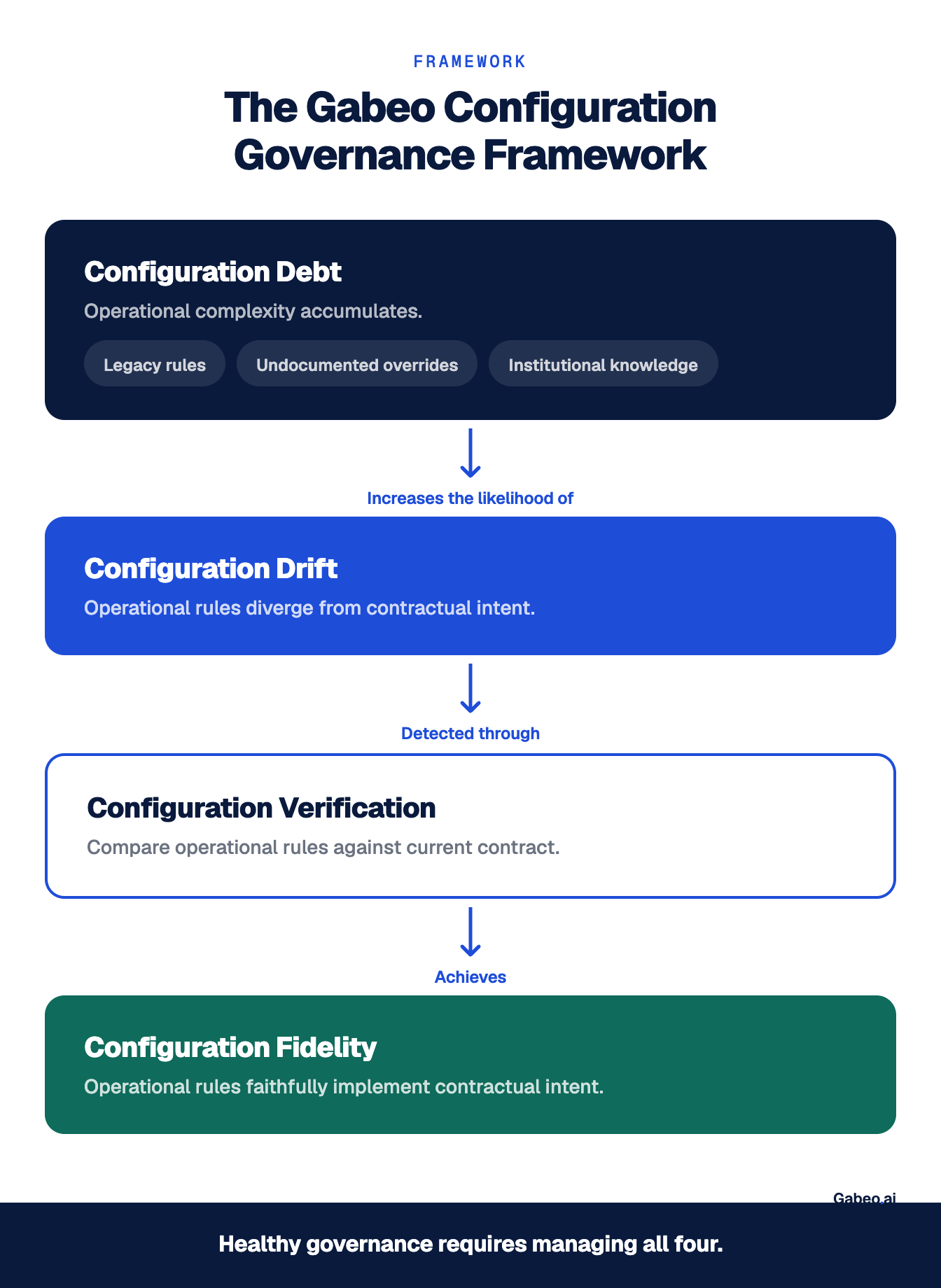
Key Takeaways
- Configuration Debt is the accumulated burden of undocumented rules, obsolete overrides, inherited configurations, and institutional knowledge that increases the probability of future DOFR errors.
- Unlike Configuration Drift, which measures whether current configuration matches the contract, Configuration Debt measures the operational conditions that make future divergence more or less likely.
- Configuration Debt accumulates through five common mechanisms: undocumented overrides, obsolete rules, inherited configurations, institutional knowledge dependencies, and deferred documentation.
- Configuration Debt rarely becomes visible during routine operations. It typically emerges during contract amendments, platform migrations, staffing transitions, audits, or reconciliation efforts.
- Organizations reduce Configuration Debt through disciplined documentation, lifecycle management, configuration audits, knowledge transfer, and periodic simplification of legacy configuration.
- Long-term Configuration Fidelity requires both ongoing verification and active management of Configuration Debt.
Frequently Asked Questions
What is Configuration Debt?
Configuration Debt is the accumulated operational complexity created by undocumented rules, obsolete overrides, inherited configurations, and institutional knowledge dependencies within claims adjudication systems. Like technical debt in software engineering, it makes future changes progressively more difficult, slower, and riskier.
How is Configuration Debt different from Configuration Drift?
Configuration Drift measures whether current operational rules accurately reflect current contractual requirements.
Configuration Debt measures the operational conditions that increase the likelihood that future changes will introduce Configuration Drift.
Drift is an observable state.
Debt is an underlying condition.
Organizations need to manage both.
Why does Configuration Debt matter?
Configuration Debt increases implementation complexity with every contract amendment.
As complexity grows, organizations require more effort to understand existing configuration, evaluate dependencies, and safely implement changes.
Left unmanaged, Configuration Debt increases the likelihood of financial responsibility errors, reconciliation discrepancies, and governance challenges.
Can Configuration Debt be eliminated?
No.
Some degree of Configuration Debt is inevitable in long-lived delegated healthcare environments.
The goal is not elimination.
The goal is ensuring Configuration Debt remains understood, documented, measurable, and manageable so it does not materially increase operational risk.
How should organizations begin reducing Configuration Debt?
Most organizations should begin by:
- Reviewing undocumented overrides.
- Removing obsolete configuration.
- Improving documentation standards.
- Reducing institutional knowledge dependencies.
- Treating platform migrations as opportunities to simplify configuration rather than simply replicate it.
Continue Your DOFR Learning
Configuration Debt is one part of a broader Configuration Governance framework developed by Gabeo.
Explore these related publications:
Foundations
Understanding Division of Financial Responsibility (DOFR) Agreements
The Three-Way Model of Financial Responsibility
Configuration Governance
Why Static DOFR Configuration Eventually Fails (Configuration Drift)
Configuration Fidelity: Verifying That Operational Rules Match the Contract
The Delegation Oversight Blind Spot: DOFR Configuration Accuracy
Operational Concepts
Why DOFR Errors Don't Generate Denials
About Gabeo
Gabeo helps health plans, delegated entities, and value-based care organizations improve visibility into delegated financial responsibility through practical governance frameworks, operational analysis, and technology purpose-built for delegated risk.
Our mission is to make financial responsibility transparent, measurable, and verifiable so organizations can reduce hidden payment errors, strengthen governance, and improve confidence that operational configuration continues to reflect contractual intent.
Learn more at https://www.gabeo.ai.
Final Thoughts
Every delegated organization accumulates Configuration Debt.
The difference between mature and immature organizations is not whether debt exists.
It is whether that debt is understood, measured, and intentionally reduced before it affects financial responsibility.
Configuration Drift explains how operational rules diverge from contractual intent.
Configuration Debt explains why maintaining accuracy becomes progressively more difficult over time.
Configuration Fidelity defines the operational state organizations should strive to achieve.
Together, these three concepts provide a practical framework for understanding the long-term health of delegated financial responsibility.
Organizations that actively manage Configuration Debt will implement contractual changes more confidently, reduce reconciliation effort, strengthen governance, and improve confidence that financial responsibility continues to reflect the contracts they have agreed to.