The Delegation Oversight Blind Spot: DOFR Configuration Accuracy
Health plans remain accountable for delegated claims processing, but many oversight programs do not directly verify whether DOFR configuration reflects current contract terms. Learn why this oversight gap matters and how configuration verification strengthens delegated risk governance.

Health plans routinely delegate claims processing to medical groups and independent practice associations (IPAs).
They do not delegate accountability.
Whether a delegated entity adjudicates one claim or one million, the health plan remains responsible for ensuring those claims are processed in accordance with contractual agreements, regulatory requirements, and the financial responsibility defined in the Division of Financial Responsibility (DOFR).
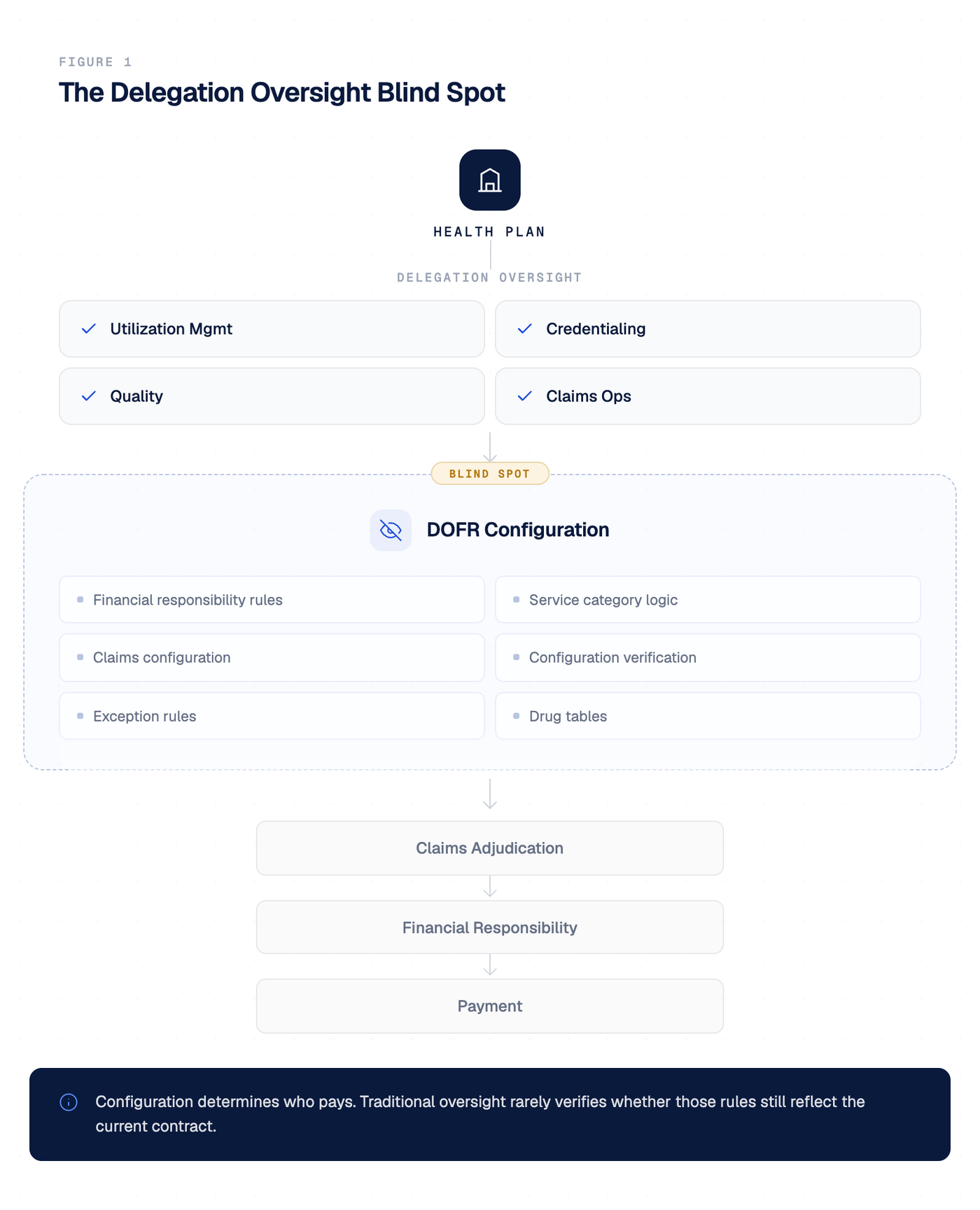
Most delegation oversight programs recognize this responsibility. They audit utilization management. They verify credentialing compliance. They monitor quality performance, timely access standards, member grievances, and claims operations through established oversight programs.
Yet one delegated function often receives far less direct verification than its financial importance warrants:
DOFR configuration accuracy.
The DOFR determines which organization bears financial responsibility for every covered service category within a delegated arrangement. When those contractual rules are translated into a delegated entity's claims adjudication system, they become the operational logic that determines who ultimately pays each claim.
If that configuration no longer reflects the current contract, claims continue processing normally.
Providers receive payment.
Members receive care.
Operations appear healthy.
The financial responsibility, however, may be assigned to the wrong organization.
No denial is generated.
No operational alert appears.
The discrepancy often remains invisible until reconciliation months later.
Health plan executives responsible for delegated networks therefore face an important governance challenge.
How do you maintain accountability for operational rules that you cannot directly observe?
The Accountability Paradox
Delegation exists to improve operational efficiency.
Health plans routinely delegate claims administration, utilization management, credentialing, and other specialized functions to organizations that possess the expertise and operational infrastructure required to perform them effectively.
Operational execution changes hands.
Accountability does not.
This creates a fundamental paradox.
The organization ultimately responsible for financial responsibility decisions frequently lacks direct visibility into the operational rules producing those decisions.
Delegation oversight programs are designed to reduce this risk.
They review documented policies.
They evaluate operational procedures.
They assess staffing models.
They monitor quality metrics.
They verify regulatory compliance.
These oversight activities provide confidence that delegated organizations are following established operational processes.
What they do not necessarily demonstrate is whether the configuration inside a delegated claims adjudication system faithfully reflects the current DOFR agreement.
That distinction is increasingly important.
A delegated entity may follow every documented process correctly while still implementing an incorrect financial responsibility rule because of an interpretation error, an overlooked contract amendment, or an incomplete configuration update.
The process succeeds.
The configuration does not.
Traditional oversight verifies the former.
Increasingly, delegated risk organizations must also verify the latter.
Delegation transfers operational execution. It does not transfer accountability.
Why Delegation Oversight Programs Miss DOFR Configuration
Delegation oversight has matured significantly over the past decade.
CMS expects Medicare Advantage organizations to continuously monitor delegated functions while conducting formal periodic assessments.
DMHC requires California health plans to oversee the financial and operational capacity of delegated entities.
NCQA evaluates delegation oversight as part of accreditation standards.
These oversight frameworks collectively examine a broad range of delegated activities.
Utilization management.
Credentialing.
Quality improvement.
Member services.
Claims processing.
When auditors evaluate claims processing, they typically verify that delegated entities process claims within required timelines, apply appropriate fee schedules, calculate member liability correctly, and comply with contractual service standards.
What they rarely evaluate is whether the DOFR configuration inside the delegated claims platform continues to reflect the current contractual agreement.
This gap exists for three structural reasons.
First, DOFR configuration is largely invisible outside the delegated entity.
Health plans can review claims outcomes.
They can review reports.
They can evaluate reconciliation results.
What they typically cannot observe directly are the configuration tables within systems such as QNXT, HealthEdge, Facets, or proprietary claims platforms that determine financial responsibility before a claim adjudicates.
Verifying configuration requires access to operational rules rather than operational outcomes.
Second, DOFR configuration errors rarely generate the signals traditional oversight programs are designed to detect.
When financial responsibility is assigned incorrectly because of DOFR misconfiguration, the claim still adjudicates successfully.
The member receives care.
The provider receives payment.
The claim closes normally.
The only error is that the financial responsibility was assigned to the wrong organization.
That mistake does not generate a denial.
It does not create a work queue.
It does not trigger an operational alert.
Its only evidence is a financial entry posted to the wrong ledger, where it often appears indistinguishable from a legitimate payment until reconciliation compares it with the contract.
Third, DOFR configuration changes continuously.
Drug approvals.
Benefit design revisions.
Contract amendments.
Regulatory requirements.
Exception table updates.
Each change requires corresponding updates within the delegated claims configuration.
A delegation oversight assessment performed early in the year may accurately reflect the configuration at that moment while failing to identify changes introduced during subsequent amendment cycles.
By the next annual review, multiple rounds of contractual changes may already have occurred.
This gradual divergence between contractual intent and operational configuration is what Gabeo describes as Configuration Drift.
Configuration Drift does not necessarily indicate poor operational discipline.
It reflects the practical reality that contracts evolve continuously while configuration verification often occurs only periodically.
Without deliberate verification, even well-managed delegated organizations can gradually drift away from the financial responsibility defined in the current contract.
The Financial Exposure Health Plans Cannot See
When DOFR configuration at a delegated entity diverges from the current contract, the financial consequences extend well beyond reconciliation.
Unlike many operational failures, these discrepancies often remain invisible to the dashboards health plan executives review every month.
Claims volume appears normal.
Turnaround times remain within service levels.
Provider complaints may be minimal.
Denial rates remain stable.
From an operational perspective, the delegated arrangement appears healthy.
Financial responsibility, however, may already be drifting away from contractual intent.
The consequences generally fall into three categories.
Overpayment Exposure
When delegated configuration assigns health plan responsibility for services that the contract assigns to the medical group or IPA, the health plan pays claims that should have been covered through capitation.
Those payments appear to be legitimate plan-risk claims.
Nothing in the adjudication process suggests otherwise.
Over time, these payments accumulate quietly, increasing claims expense while obscuring the true financial performance of the delegated contract.
Because the root cause is configuration rather than utilization, traditional cost trend analysis rarely identifies the underlying issue.
Underpayment Exposure and Provider Abrasion
The opposite error creates a different problem.
When delegated configuration assigns medical group responsibility for services that should remain plan risk, providers experience delayed payment, indirect underpayment, or extended reconciliation cycles.
Eventually the delegated entity identifies the discrepancy.
The financial correction may occur months later.
The provider, however, experiences only the operational friction.
Gabeo refers to this downstream consequence as Provider Abrasion.
Providers rarely know that a DOFR configuration issue created the delay.
They simply experience slower reimbursement, greater administrative effort, and increasing frustration.
Over time, this friction weakens provider relationships and can contribute to network dissatisfaction even though the health plan's own systems processed every claim exactly as configured.
Executive Decision Risk
Perhaps the least appreciated consequence is the effect on executive decision-making.
Financial reports assume that claims costs reflect contractual responsibility.
When configuration no longer reflects the contract, those reports begin measuring configuration error alongside actual utilization.
Leaders attempting to understand cost trends, delegated entity performance, or capitation adequacy may unknowingly make strategic decisions using distorted financial information.
The question shifts from:
"Why did utilization increase?"
to:
"Did utilization increase, or did financial responsibility change because configuration drifted away from the contract?"
Without configuration verification, those two possibilities become difficult to distinguish.
Research on capitation reconciliation suggests that underpayments in a 400,000-member health plan can reach several million dollars annually.
Although those discrepancies arise from multiple operational causes, DOFR configuration remains a foundational input to every reconciliation process.
When financial responsibility is configured incorrectly, reconciliation can identify the discrepancy.
It cannot prevent it.
A functioning claims system demonstrates operational consistency. It does not demonstrate contractual accuracy.
What Regulators Are Signaling
The regulatory environment continues to place increasing emphasis on accountability for delegated functions.
While regulators may not specifically identify DOFR configuration as an independent audit category, they consistently reinforce a broader expectation.
Health plans remain responsible for ensuring delegated organizations perform contracted functions accurately and effectively.
CMS has increasingly emphasized patterns of operational performance rather than isolated findings.
Recurring deficiencies associated with the same delegated entity suggest systemic weaknesses rather than individual operational mistakes.
Repeated reconciliation discrepancies involving the same categories of financial responsibility raise an important governance question.
Is the delegated organization experiencing isolated claims issues?
Or does its operational configuration no longer faithfully represent the contract?
That distinction matters because recurring configuration discrepancies are unlikely to resolve themselves through traditional operational improvement efforts alone.
California's Department of Managed Health Care reinforces a similar principle.
Risk-bearing organizations are expected to maintain the administrative and operational capabilities necessary to fulfill their contractual obligations.
Accurately implementing delegated financial responsibility is not simply a technical exercise.
It is an operational capability that directly affects financial performance, provider relationships, and contractual compliance.
The legal environment points in the same direction.
Courts have repeatedly recognized that delegation does not eliminate a health plan's responsibility to exercise appropriate oversight over delegated activities.
Whether oversight is ultimately judged sufficient depends on the specific circumstances of each case.
The broader principle, however, remains consistent.
Delegation transfers operational execution.
It does not transfer accountability.
As delegated arrangements become increasingly sophisticated, the next logical evolution in oversight is extending traditional process verification to include the operational rules that determine financial responsibility.
Configuration is no longer merely an implementation detail.
It is becoming a governance concern.
What Effective DOFR Oversight Looks Like
Closing this blind spot does not require health plans to build an entirely new oversight program.
It requires extending existing delegation oversight to include one additional question:
Do the delegated entity's operational rules still faithfully reflect the current contract?
That question moves oversight beyond process compliance and toward configuration governance.
Organizations can begin making that transition through four practical practices.
Verify Configuration at Every Amendment Cycle
Annual delegation audits provide a useful snapshot.
DOFR configuration, however, changes whenever the contract changes.
Drug approvals.
Benefit design revisions.
New carve-outs.
Service category refinements.
Contract amendments.
Each of these requires corresponding updates within the delegated entity's claims configuration.
Rather than simply confirming that an update occurred, mature oversight verifies that the active configuration reflects the most recent contractual agreement.
The question is not:
"Did you update the system?"
The question is:
"Do the current operational rules match the current contract?"
Sample High-Ambiguity Service Categories
Not every service category presents the same operational risk.
Most DOFR discrepancies concentrate around a relatively small number of high-ambiguity category boundaries.
Examples include:
- Chemotherapy versus infusion services
- Injectable medications versus infusion administration
- Diagnostic testing versus laboratory services
- Radiation therapy versus diagnostic radiology
These categories frequently depend upon drug reference tables, exception logic, contract-specific interpretation, and evolving reimbursement guidance.
Sampling these categories during oversight provides a more effective assessment than reviewing randomly selected claims.
When discrepancies appear within high-ambiguity categories, they often indicate broader configuration issues requiring additional review.
Analyze Reconciliation Trends
Most health plans already possess valuable oversight data.
They simply analyze it from a financial perspective rather than a governance perspective.
Reconciliation adjustments provide an important operational signal.
Questions worth asking include:
- Are adjustments increasing over time?
- Do discrepancies consistently favor one organization?
- Are the same service categories appearing repeatedly?
- Do the same delegated entities require recurring corrections?
Viewed together, these patterns may indicate Configuration Drift rather than isolated operational mistakes.
Reconciliation should not simply resolve discrepancies.
It should also identify the operational conditions creating them.
Measure Configuration Accuracy
Traditional delegation scorecards evaluate process.
Mature scorecards evaluate outcomes.
Organizations should begin treating configuration accuracy as a measurable operational capability.
Possible indicators include:
- Percentage of sampled claims matching current DOFR contract terms
- Average time between contract amendment and production configuration
- Number of recurring reconciliation adjustments by delegated entity
- Frequency of high-ambiguity category discrepancies
- Configuration verification completion rate following each amendment cycle
These measures provide objective evidence that delegated financial responsibility continues to reflect contractual intent rather than relying solely upon procedural compliance.
Configuration governance begins when organizations verify operational rules, not simply operational processes.
Closing the Accountability Gap
The central challenge facing health plan executives is surprisingly simple.
You remain accountable for decisions produced by operational rules you often cannot directly observe.
Delegation oversight can verify that a delegated organization has documented procedures for updating DOFR configuration.
It can confirm that qualified personnel perform those updates.
It can review training materials, internal audits, reconciliation reports, and quality metrics.
None of those activities demonstrate that the rules currently operating inside the delegated claims system faithfully represent the current contract.
That distinction defines the accountability gap.
An organization may follow every documented procedure correctly while introducing a configuration error during implementation.
An amendment may be interpreted incorrectly.
An exception table may not be updated.
A service category may be mapped using outdated business rules.
Every documented process succeeds.
The resulting configuration is still incorrect.
Traditional oversight evaluates the process.
Configuration verification evaluates the outcome.
As delegated healthcare continues to evolve, this distinction becomes increasingly important.
Health plans have invested decades refining oversight programs that verify operational execution.
The next stage of maturity is extending those programs to verify configuration accuracy as well.
Configuration Fidelity provides the operational standard.
Delegation oversight provides the governance framework.
Together they establish a more complete approach to ensuring delegated financial responsibility remains aligned with contractual intent.
Key Takeaways
- Health plans remain accountable for delegated claims processing even when operational execution is performed by another organization.
- Most delegation oversight programs verify operational processes but do not directly verify whether delegated DOFR configuration continues to reflect current contract terms.
- Wrong-party payments frequently originate from configuration discrepancies that generate no traditional operational signals, making them difficult to detect before reconciliation.
- High-ambiguity service categories deserve focused oversight because they concentrate a disproportionate share of DOFR configuration errors.
- Mature delegation oversight extends traditional process verification by incorporating configuration verification as an ongoing operational capability.
Frequently Asked Questions
What is delegation oversight?
Delegation oversight is the process by which a health plan monitors and evaluates delegated entities to ensure they perform contracted functions in accordance with contractual obligations, regulatory requirements, and organizational expectations. Oversight commonly includes utilization management, credentialing, quality improvement, member services, claims operations, financial performance, and periodic operational audits.
What is DOFR configuration?
DOFR configuration is the implementation of a Division of Financial Responsibility (DOFR) agreement within a claims adjudication system.
It translates contractual financial responsibility into operational rules that determine which organization pays each claim based on the applicable service category, benefit design, and contract terms.
Why isn't DOFR configuration typically included in delegation oversight?
Traditional delegation oversight programs primarily evaluate operational processes and outcomes rather than the configuration logic inside claims adjudication systems.
Because most configuration discrepancies do not generate denials, work queues, or other operational alerts, they often remain invisible until financial reconciliation identifies a discrepancy.
What is Configuration Drift?
Configuration Drift is the gradual divergence between current contractual intent and the operational rules implemented within a claims adjudication system.
It commonly occurs as contracts evolve through amendments, benefit changes, regulatory updates, drug table revisions, and service category refinements while configuration verification occurs less frequently.
What is Configuration Fidelity?
Configuration Fidelity is the measurable state in which operational rules faithfully represent the current delegated financial responsibility agreement they implement.
Rather than assuming configuration remains correct, Configuration Fidelity emphasizes ongoing verification that operational rules continue to align with the most current contractual requirements.
How can health plans improve oversight of DOFR configuration?
Organizations can strengthen delegation oversight by incorporating configuration verification into existing governance activities.
Examples include reviewing high-ambiguity service categories following contract amendments, analyzing reconciliation trends for recurring configuration patterns, verifying implementation of financial responsibility changes before production, and measuring configuration accuracy as an operational performance indicator.
Final Thoughts
Delegation has transformed healthcare operations by allowing specialized organizations to administer increasingly complex functions.
Oversight has evolved alongside it, establishing mature processes for evaluating quality, compliance, utilization management, credentialing, and claims administration.
The next stage of that evolution is not simply performing more audits.
It is expanding oversight to verify that the operational rules assigning financial responsibility continue to reflect the current contract.
Health plans cannot delegate accountability.
Increasingly, they must also be able to demonstrate it.
As delegated risk arrangements continue to grow in complexity, organizations that verify configuration alongside process will be better positioned to reduce reconciliation discrepancies, strengthen provider relationships, improve financial stewardship, and demonstrate effective governance over delegated financial responsibility.
Continue Your DOFR Learning
The concepts discussed in this article build on other topics in the Gabeo DOFR Resource Center. Explore the articles below to deepen your understanding of delegated financial responsibility, configuration governance, and delegated risk operations.
Foundations
What Is a DOFR? The Complete Guide to Division of Financial Responsibility
Understand what a Division of Financial Responsibility (DOFR) agreement is, why it exists, and how it governs financial responsibility in delegated healthcare.
The Three-Way Model of Financial Responsibility
Explore the three fundamental financial responsibility models that underpin delegated healthcare.
Operational Risks
Why DOFR Errors Don't Generate Denials
Learn why DOFR configuration errors rarely trigger denials or operational alerts, allowing financial responsibility errors to remain hidden until reconciliation.
Provider Abrasion: The Hidden Cost of Financial Responsibility Errors
See how configuration discrepancies create downstream provider friction, payment delays, and unnecessary administrative burden.
The Translation Chain: From Contract Language to Claims Adjudication
Learn how contractual intent becomes executable claims configuration, and where implementation errors can occur.
Configuration Drift: Why Static DOFR Configuration Eventually Fails
Explore why DOFR configuration naturally diverges from evolving contracts over time.
Configuration Fidelity: Verifying That Operational Rules Match the Contract
Learn why organizations should verify that operational claims configuration continues to faithfully reflect current contractual intent.
Governance
The Delegation Oversight Blind Spot: DOFR Configuration Accuracy
You are here.
Learn why configuration verification is becoming an essential component of mature delegation oversight.
About the Gabeo DOFR Resource Center
The Gabeo DOFR Resource Center is building a comprehensive body of knowledge for delegated financial responsibility, delegated risk operations, and configuration governance.
Our mission is to help health plans, delegated entities, provider organizations, and value-based care leaders better understand the operational, financial, and governance challenges of delegated healthcare through practical frameworks, original research, and evidence-based guidance.
Explore the full DOFR Resource Center