Configuration Fidelity: How to Know Whether DOFR Rules Match the Contract
Configuration Fidelity is the operational standard for verifying that claims configuration faithfully reflects the current DOFR contract. Learn how the Translation Chain and three verification dimensions: Completeness, Accuracy, and Currency to help reduce Configuration Drift.

Executive Summary
Configuration Drift explains how claims configuration gradually diverges from the contracts it was intended to implement.
Configuration Fidelity defines the standard for determining whether that divergence has occurred.
A claims system can process claims, assign financial responsibility, and generate no operational errors while still executing rules that no longer reflect the current contract.
Functioning configuration is not evidence of faithful configuration.
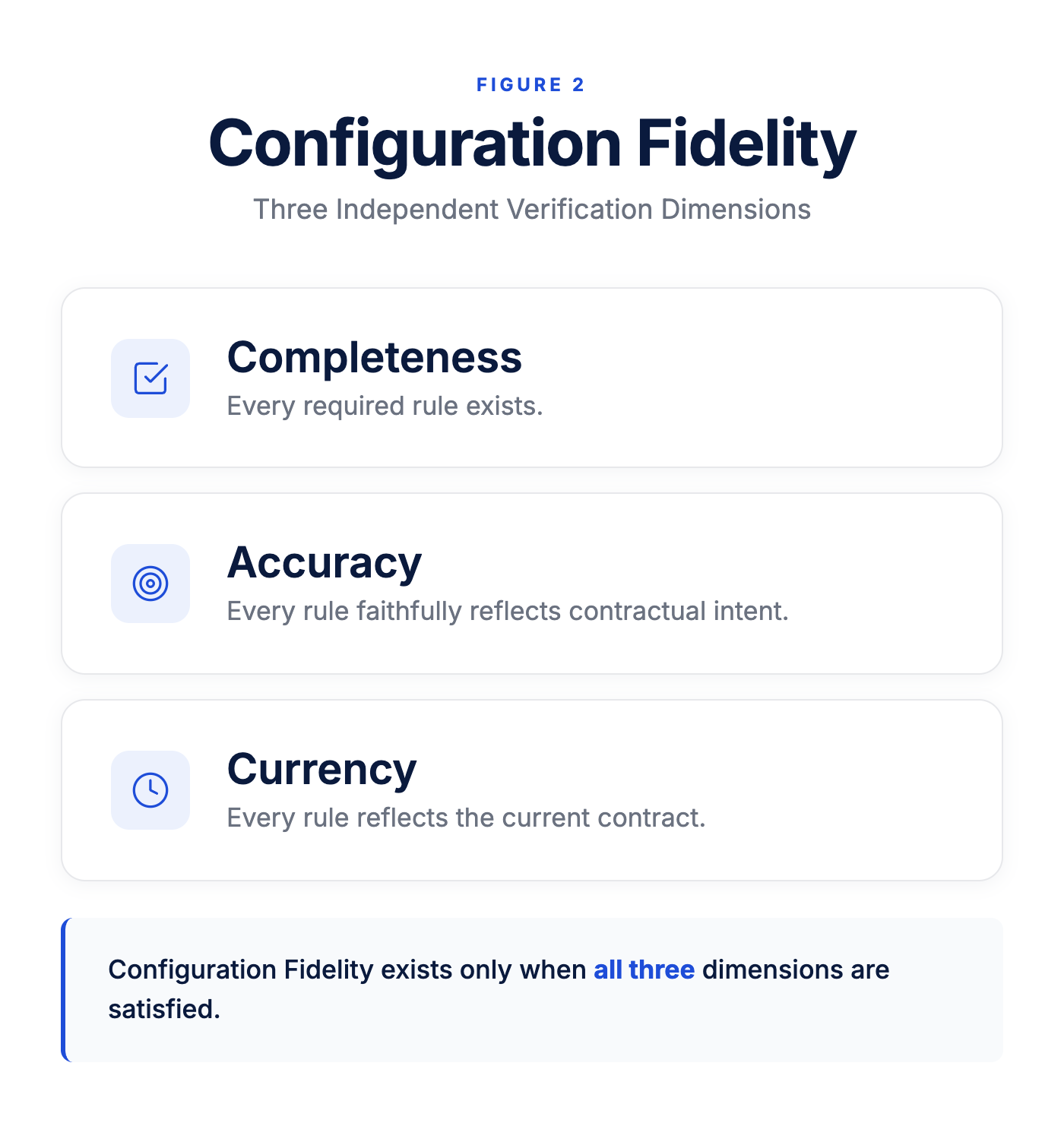
Configuration Fidelity requires organizations to verify three things:
- Completeness: Every required rule exists.
- Accuracy: Every rule reflects the intended contract term.
- Currency: Every rule reflects the current contract, including amendments and approved exceptions.
Without verification, confidence in configuration is based on assumption rather than evidence.
Framework: Configuration Fidelity
Definition
The measurable state in which every operational rule faithfully represents the current terms of the DOFR contract it implements.
Purpose
Provide the verification standard used to detect, measure, and reduce Configuration Drift.
Verification dimensions
- Rule Completeness
- Rule Accuracy
- Rule Currency
Related frameworks
- Configuration Drift
- Translation Chain
- Fidelity Gap
- Configuration Surface Area
Configuration Fidelity is not necessarily uniform across an organization. One contract, rule set, or service category may be verified while another remains unknown.
The goal is not to assume that configuration is correct. The goal is to make its condition visible, measurable, and supportable with evidence.
The Translation Chain
Every claims configuration is the result of translation.
Contracts are written for legal and business purposes. Claims systems execute structured rules. Between those two realities lies a series of human decisions that interpret contractual language and convert it into operational logic.
This sequence is the Translation Chain.
Translation Chain: The sequence of interpretations and implementations that converts contractual language into executable claims-system rules.
No claims system reads a contract and independently determines how to enforce its terms. Every implementation depends on people interpreting contract language, deciding how it should operate, and configuring the system accordingly.
Each step introduces the possibility of variation. Each interpretation creates an opportunity for misunderstanding. Each manual implementation creates the possibility that the operational rule will no longer reflect contractual intent.
The four stages
- DOFR Contract — What the parties agreed to.
- Operational Interpretation — What the organization understands the agreement to mean.
- System Configuration — How that interpretation is expressed as executable rules.
- Financial Responsibility Decision — The result produced when those rules are applied to a claim.
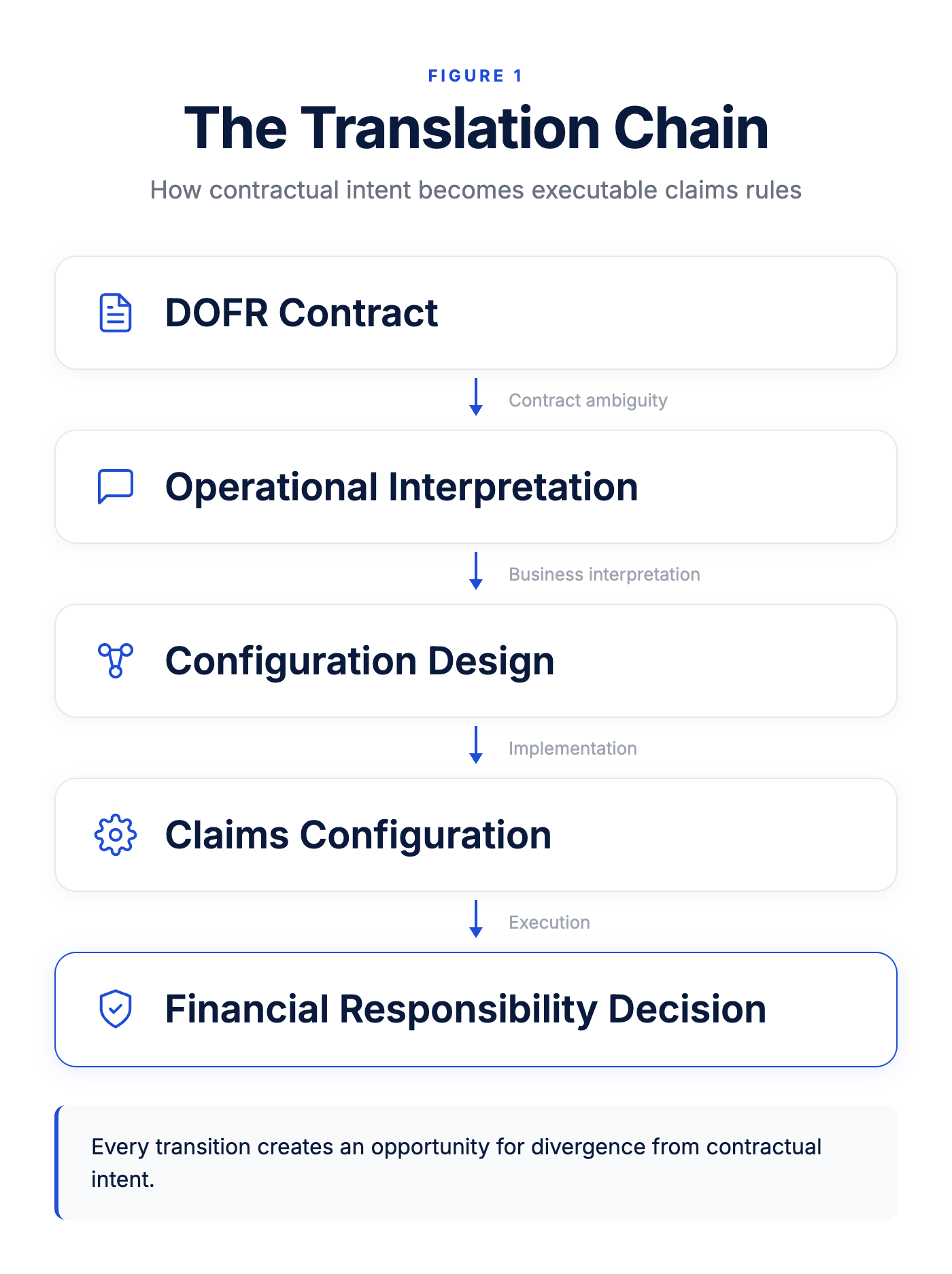
Contract to interpretation
The signed, effective DOFR contract is the source of truth for what configuration should accomplish. It may include schedules, matrices, exhibits, amendments, service categories, and exceptions.
Some provisions are precise. Others require judgment.
A contract may assign “Chemotherapy” to the health plan without making clear whether a specific biosimilar administered in an outpatient hospital setting belongs under Chemotherapy or Infusion Services within the payer's classification method.
Ambiguity in the contract becomes ambiguity in everything downstream.
Interpretation to configuration
Claims operations translates contractual language into operational meaning.
Teams decide which CPT and HCPCS codes belong to each service category, how drug-table changes affect classification, which exceptions override standard rules, and which contract version governs a claim based on date of service.
This is where institutional knowledge often becomes critical.
An experienced examiner may understand how a payer interprets a category, which edge cases were resolved informally, and which exceptions have historically applied. That knowledge may be operationally essential even when it does not appear in the contract.
When it is undocumented, the Translation Chain depends on what one person remembers.
Configuration to decision
The adjudication platform implements the operational interpretation.
Codes are mapped to categories. Drug tables are loaded. Exception logic is configured. Revenue codes are routed. Effective dates are established.
The system does not consult the contract. It does not apply institutional knowledge. It executes the rules it was given.
If those rules faithfully represent the contract, financial responsibility is assigned correctly.
If they have drifted, the system can assign responsibility incorrectly while continuing to function normally.
Where the chain breaks
Divergence can occur at every transition:
- Contract ambiguity: The agreement does not provide enough specificity for consistent interpretation.
- Institutional knowledge: Operational decisions depend on undocumented experience or informal guidance.
- Implementation error: The organization understands the requirement but configures it incorrectly.
- Amendment lag: The contract changes before the corresponding rule is updated.
- Version mismatch: Correct rules are attached to the wrong effective dates or contract version.
Configuration errors rarely originate in the claims engine itself.
They originate earlier, during interpretation, implementation, or maintenance. The claims engine simply executes the rules it was given.
Working Is Not the Same as Correct
One of the most persistent assumptions in claims operations is that a functioning system is a correct system.
It is an understandable assumption.
Claims are processing. Financial responsibility is being assigned. Providers are being paid. Few claims require manual intervention. From an operational perspective, everything appears to be working.
Yet none of those observations demonstrates that the underlying configuration still reflects the current contract.
A claims system evaluates only the rules it has been given.
It does not compare those rules with the latest amendment. It does not recognize that a service category has been redefined. It does not question whether an exception was implemented correctly.
It simply executes the configured logic, consistently and at scale.
That consistency is often mistaken for correctness.
Operational success is evidence that the system executed its rules. It is not evidence that those rules still represent the current contract.
A stable claims engine demonstrates operational consistency.
It does not demonstrate contractual fidelity.
Why divergence remains hidden
Organizations rarely intend to let configuration drift away from contractual intent. Divergence develops gradually.
An amendment is implemented in one area but overlooked in another. A new exception is communicated informally but never documented. An experienced analyst leaves, taking years of implementation knowledge with them. Configuration copied from a previous contract is assumed to be correct without being revalidated.
None of these events necessarily causes an immediate operational failure.
Claims continue to process. Providers continue to submit claims. Payments continue to be issued.
The organization receives continuous evidence that the system is functioning.
It receives almost no evidence that the configuration remains faithful to the contract.
The Fidelity Gap
The Fidelity Gap is the measurable difference between what the current contract requires and what the operational configuration currently does.
Every unverified amendment, unconfirmed drug-table update, undocumented exception, and inherited rule with unknown provenance can contribute to that gap.
The Fidelity Gap may be expressed through measures such as:
- Number of unverified rules
- Percentage of active configuration not confirmed against the current contract
- Number of amendments without verified implementation
- Time since each rule or rule set was last verified
- Number of rules with unknown ownership, rationale, or source
Organizations do not move suddenly from correct to incorrect. The gap usually widens incrementally as changes accumulate without complete verification. It narrows when the organization verifies, corrects, and documents the affected rules.
Verifying Configuration Fidelity
Configuration Fidelity cannot be established through operational performance alone.
It requires deliberate verification.
The question is not whether claims process successfully. The question is whether every operational rule can be demonstrated to faithfully represent the current contract.
That verification depends on three independent dimensions.
1. Rule Completeness
Every contractual obligation that affects financial responsibility must be represented in the operational configuration.
Missing rules are difficult to identify because the system cannot alert the organization to something that was never implemented.
Examples include:
- A service category that was never configured
- An amendment that introduced new requirements without corresponding rule changes
- A contract exception omitted from operational logic
- A provider-specific rule that was never implemented
Rule Completeness asks:
Has every contractual requirement been translated into an operational rule?
2. Rule Accuracy
Every implemented rule must faithfully represent the intended contractual meaning.
A rule can exist and still be wrong. A waiting period may be configured incorrectly. A financial threshold may use the wrong calculation. An exception may be attached to the wrong service category. Eligibility criteria may be implemented differently from the agreement.
The rule exists. The system executes it consistently. The implementation is simply incorrect.
Rule Accuracy asks:
Does every configured rule faithfully represent the contractual requirement it was intended to implement?
3. Rule Currency
Even accurate configuration becomes unreliable when it no longer reflects the current contract.
Contracts evolve. Amendments are signed. Coverage changes. Service categories expand. Drug tables and exceptions are revised.
Each contractual change creates a new verification obligation.
Rule Currency asks:
Does every operational rule reflect the current contract, including amendments, revisions, and approved exceptions?
All three dimensions are required
Configuration Fidelity exists only when all three dimensions are satisfied.
A configuration that is complete but inaccurate does not faithfully implement the contract.
A configuration that is accurate but incomplete leaves contractual obligations unenforced.
A configuration that is complete and accurate but no longer current continues to enforce yesterday's agreement.
Each dimension is necessary. None is sufficient on its own.
Why Configuration Fidelity Is Difficult to Verify
If Configuration Fidelity depends on evidence, why is it so difficult for organizations to demonstrate?
The challenge is not that claims systems are incapable of executing complex rules.
The challenge is that most organizations cannot reconstruct the complete path from the current contract to the configuration that exists today.
Configuration evolves through years of negotiations, operational decisions, system enhancements, exceptions, regulatory changes, and staff turnover. Each change may be reasonable on its own. Collectively, they create a configuration whose history is difficult to explain and even harder to verify.
The longer configuration has been maintained, the more likely it is that portions of its implementation depend on undocumented knowledge rather than documented evidence.
Configuration Fidelity becomes difficult not because organizations lack expertise, but because the evidence required to verify configuration has gradually disappeared.
Where evidence is lost
Evidence can disappear at every stage of the Translation Chain.
An amendment may never be linked to the configuration it changed. An implementation decision may be documented in email but nowhere else. An exception may exist without any surviving explanation of why it was created. An analyst may understand exactly why a rule exists, but that knowledge is never transferred when responsibilities change.
Over time:
Operational knowledge becomes institutional memory. Institutional memory becomes assumption.
Configuration continues to function while the evidence supporting it gradually disappears.
Common barriers
Typical barriers include:
- Amendments that cannot be traced to specific configuration changes
- Rules whose original business purpose is no longer documented
- Exceptions implemented without surviving rationale
- Multiple systems containing overlapping responsibility logic
- Ownership distributed across several departments
- Manual workarounds that became permanent operating practice
- Large Configuration Surface Areas spanning many contracts, versions, tables, and exceptions
Configuration Fidelity depends as much on preserving evidence as preserving rules.
Verification is continuous
Even a comprehensive review is perishable.
The next amendment changes the contract and creates a new verification obligation.
Configuration Fidelity is therefore not a one-time project. It is a continuous discipline renewed with every amendment, platform change, staff transition, and configuration update.
Can You Demonstrate Configuration Fidelity?
Use these questions as a practical diagnostic:
- Can every active configuration rule be traced to a current contract term?
- Can every current contract requirement be traced to an active rule?
- Can you identify when each rule was last verified?
- Can you prove that the latest amendment was implemented completely?
- Can you explain why every exception exists?
- Can you identify rules that depend on undocumented institutional knowledge?
- Can you confirm that effective-date boundaries match contract versions?
- Can you distinguish verified configuration from configuration that is merely assumed to be correct?
A “no” does not prove that a rule is wrong. It identifies an area where operational confidence is unsupported by verification.
Operational Implications
Configuration Fidelity is not simply a configuration-management concern.
It is an operational governance capability.
Organizations that cannot demonstrate Configuration Fidelity make financial responsibility decisions without being able to prove that those decisions reflect the current contract. That uncertainty affects financial performance, provider relationships, operational efficiency, governance, and organizational resilience.
Financial risk
Financial responsibility rules determine who pays for healthcare services.
When configuration no longer reflects the current contract, organizations may consistently assign responsibility incorrectly without recognizing the problem.
The financial impact may emerge gradually through adjustments, disputes, reimbursement corrections, reconciliation, or unrecovered payments. Because claims continue to process normally, the loss can remain hidden until a broader review uncovers it.
Configuration Fidelity reduces uncertainty by providing evidence that operational rules continue to reflect contractual obligations.
Provider experience
Providers experience the outcome of a financial responsibility decision, not its internal cause.
They cannot distinguish among an outdated rule, an implementation error, and an intentional business decision. They experience only an unexpected or inconsistent payment outcome.
Over time, those outcomes increase administrative work, generate avoidable disputes, and erode confidence.
Configuration Fidelity makes decisions more consistent, explainable, and traceable.
Operational efficiency
Organizations spend significant time investigating unexpected claim outcomes.
Many investigations begin with the assumption that the claims system malfunctioned. In reality, the system often executed its configured rules exactly as designed. The investigation becomes an effort to determine whether those rules still represent the contract.
Without documented evidence, each investigation begins almost from the start.
Configuration Fidelity shortens that process by preserving the information needed to understand why a rule exists, when it was implemented, and whether it remains current.
Governance and compliance
Organizations must be able to demonstrate not only how a decision was made, but why.
Rules that can be traced to documented contractual requirements are easier to audit, defend, and explain. Configuration Fidelity strengthens governance by replacing historical assumption with verifiable evidence.
Organizational resilience
People change roles. Teams reorganize. Systems are upgraded. Contracts evolve.
Organizations that depend on institutional memory lose knowledge whenever experienced staff leave.
Organizations that preserve implementation evidence retain that knowledge regardless of personnel changes.
Configuration Fidelity transforms operational knowledge from something people remember into something the organization can demonstrate.
Bottom Line
Configuration Drift explains why configuration diverges.
The Translation Chain explains how that divergence occurs.
Configuration Fidelity defines the standard for determining whether it has occurred.
A functioning claims system demonstrates that operational rules execute consistently. It does not demonstrate that those rules continue to reflect the current contract.
Without evidence, confidence in configuration is based on assumption.
With evidence, organizations can demonstrate that their operational rules faithfully implement today's contractual obligations.
Configuration Fidelity is not a software feature.
It is an organizational capability.
The question is not whether your claims system is working.
The question is whether you can demonstrate that it is faithfully executing today's contract.
Key Takeaways
- Claims systems execute configured rules; they do not verify contractual correctness.
- Every claims configuration is the product of a Translation Chain that converts contractual language into operational logic.
- Configuration Drift occurs when operational rules gradually diverge from contractual intent.
- Configuration Fidelity measures whether those rules still faithfully represent the current contract.
- Configuration Fidelity requires three independent verification dimensions: Completeness, Accuracy, and Currency.
- The Fidelity Gap makes unverified configuration visible and measurable.
- Operational confidence should be supported by evidence, not assumption.
FAQ
What is Configuration Fidelity?
Configuration Fidelity is the measurable state in which operational rules faithfully represent the current terms of the delegated financial responsibility contract they implement.
How is Configuration Fidelity different from Configuration Drift?
Configuration Drift describes the gradual divergence between contract terms and operational configuration. Configuration Fidelity defines and measures the verified state in which configuration aligns with the current contract.
Can a claims system function normally while lacking Configuration Fidelity?
Yes. A claims system can consistently execute outdated, incomplete, or incorrectly implemented rules without producing an operational error. Operational stability does not prove contractual fidelity.
Why are Completeness, Accuracy, and Currency evaluated separately?
Each addresses a different aspect of configuration quality. A configuration may satisfy one dimension while failing another. Configuration Fidelity requires all three.
Can reconciliation establish Configuration Fidelity?
No. Reconciliation can identify financial outcomes that suggest something went wrong, but it does not verify the underlying rules against the contract. Reconciliation evaluates results; Configuration Fidelity evaluates configuration.
How often should Configuration Fidelity be verified?
Affected rules should be verified after every amendment or configuration change. Targeted verification should also follow platform migrations, staff transitions, table updates, and other events that can alter or obscure operational logic.
Is Configuration Fidelity binary?
No. An organization may have high fidelity in one contract or rule set and unknown fidelity in another. The objective is to make that condition visible and measurable rather than treating all configuration as correct by default.
Why is evidence so important?
Configuration changes accumulate over time. Without evidence linking contractual requirements to operational rules, organizations cannot reliably demonstrate that configuration reflects the current agreement.
Continue Learning
- What Is a DOFR? The Complete Guide to Division of Financial Responsibility
- The Three-Way Model of Financial Responsibility
- Why DOFR Errors Don't Generate Denials
- Why Six Service Categories Generate Most DOFR Misclassification Errors
- Provider Abrasion: The Hidden Cost of Financial Responsibility Errors
- Why Static DOFR Configuration Eventually Fails
Can you demonstrate that your configuration matches today's contract?
Gabeo codifies DOFRs into versioned operational rules and audits claims against the contract evidence behind each decision.
CTA label: Book an intro call
CTA URL: https://www.gabeo.ai/contact