DOFR Glossary: The Complete Reference for Delegated Risk Terminology
The definitive glossary of DOFR and delegated risk terminology. Explore 50+ practitioner-focused definitions covering Division of Financial Responsibility, Configuration Drift, Configuration Debt, Configuration Fidelity, and other essential concepts.

New to DOFR?
If you're new to delegated risk, this glossary is the best place to learn the terminology used throughout the DOFR Resource Center.
Unlike a traditional healthcare glossary, this reference combines established delegated risk terminology with original analytical frameworks developed by Gabeo to describe operational concepts that practitioners have experienced for years but rarely had consistent names to describe.
Whether you're a health plan executive, IPA leader, MSO operator, claims examiner, consultant, actuary, or technology professional, these definitions are designed to provide practical, operational context rather than dictionary-style descriptions.
Start Here
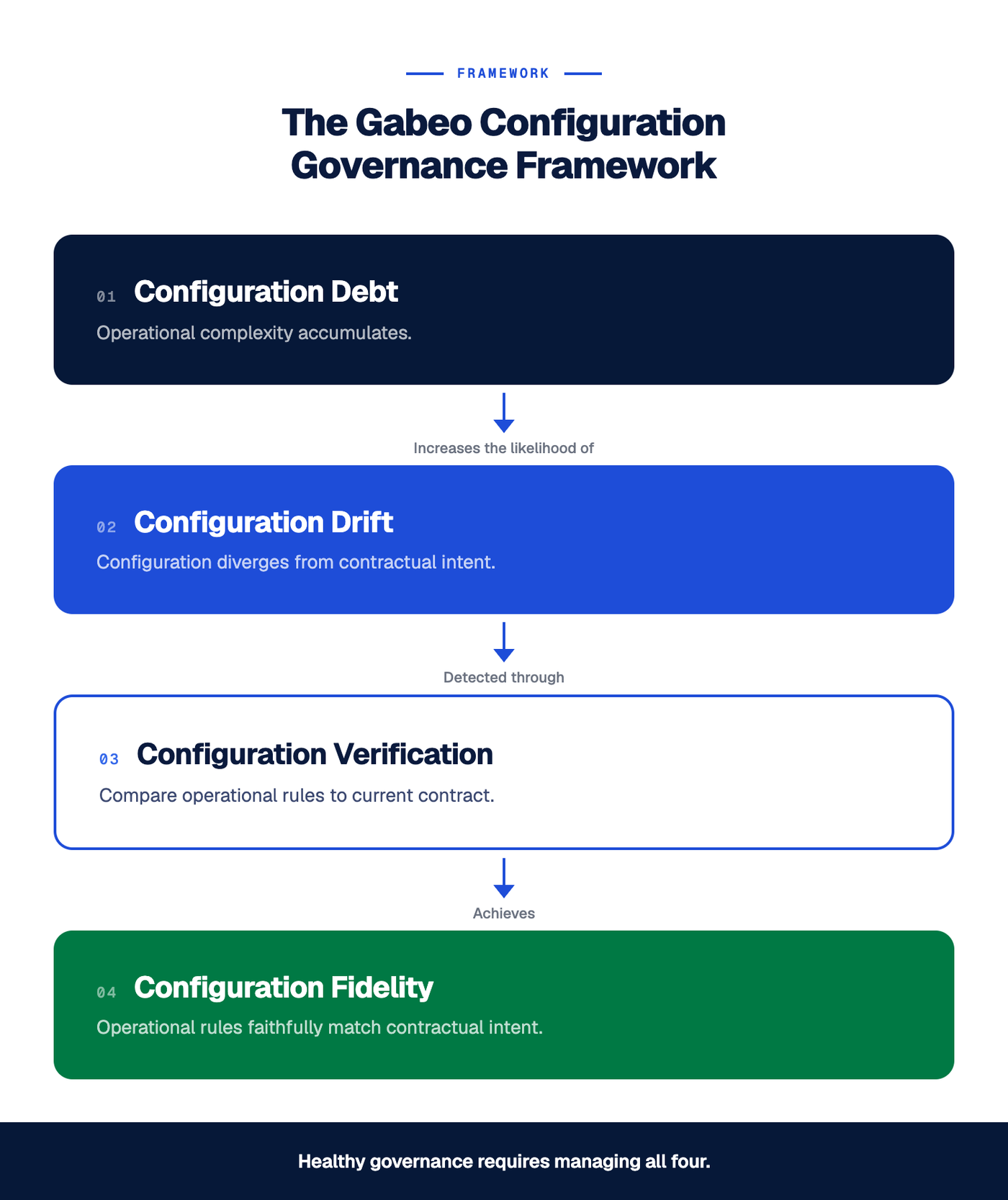
If you're new to DOFR, begin with these foundational concepts before exploring the complete glossary.
Essential Concepts
DOFR (Division of Financial Responsibility)
The contractual schedule defining which organization is financially responsible for each category of healthcare services.
DOFR Matrix
The detailed table assigning every service category to the appropriate financially responsible party.
Configuration Drift
The gradual divergence between the DOFR contract and the rules configured inside the claims adjudication system.
Configuration Debt
The accumulated operational complexity that makes future DOFR changes progressively harder to implement accurately.
Configuration Fidelity
The desired operational state where claims system configuration faithfully reflects the current DOFR contract.
Wrong-Party Payment
A claim paid by the incorrect financially responsible organization because system configuration no longer matches contractual intent.
These concepts provide the foundation for understanding delegated financial responsibility and the publications throughout the DOFR Resource Center.
How to Use This Glossary
This glossary defines the terms, frameworks, and acronyms used across the DOFR Resource Center and in delegated risk operations broadly. Each entry provides a practitioner-level definition written for people who work with DOFRs, claims configuration, and capitated payment structures daily.
Terms marked with (Gabeo Framework) are analytical frameworks introduced in the DOFR Resource Center's publications. These terms name operational concepts that practitioners have worked with for years but that lacked standard vocabulary before Gabeo defined them. Each framework entry links to the publication where it was introduced.
The glossary is organized alphabetically.
For question-and-answer coverage of common delegated risk topics, visit our DOFR FAQ:
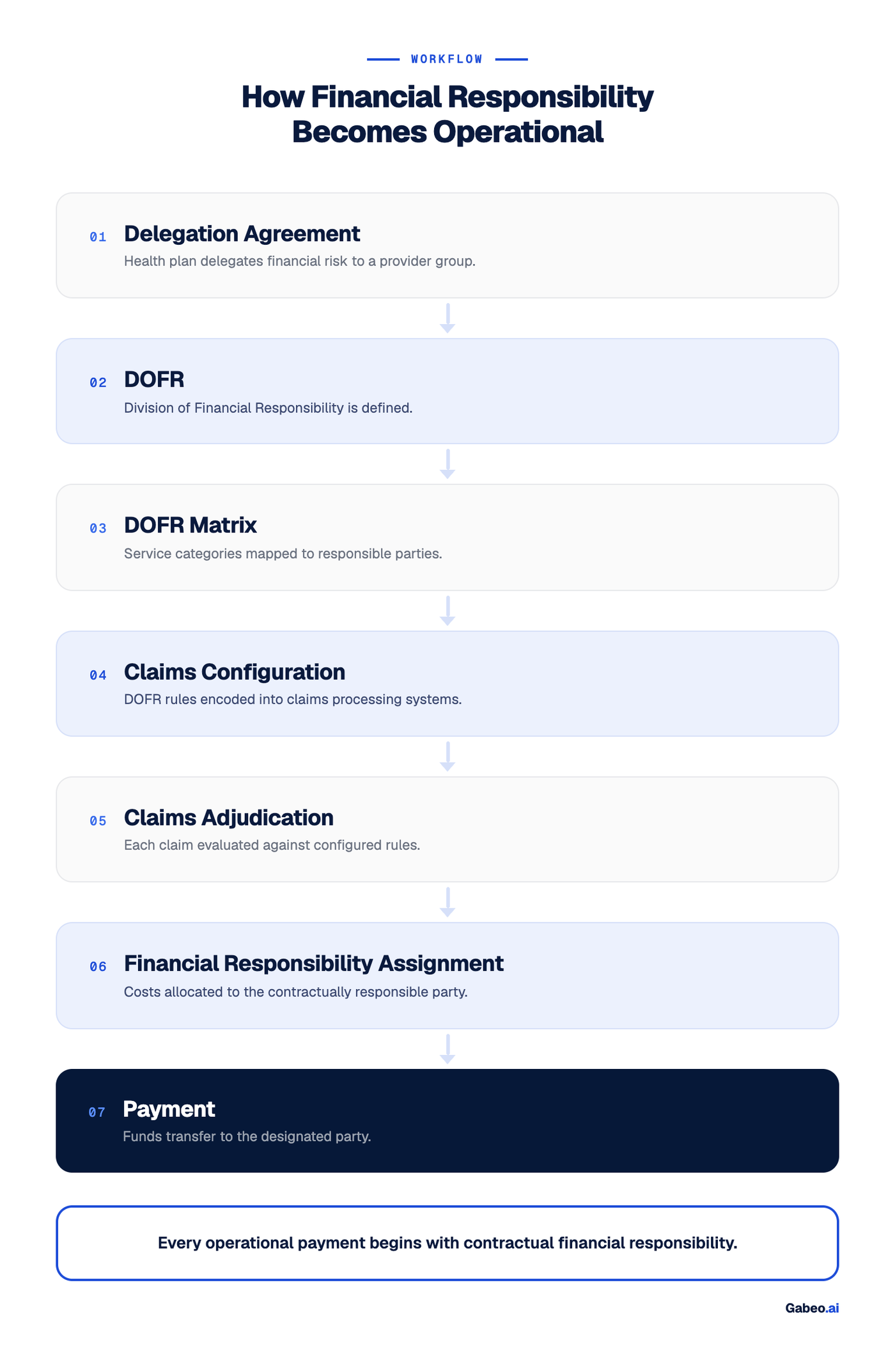
A
ACO (Accountable Care Organization)
A group of doctors, hospitals, and other healthcare providers who voluntarily coordinate care for a defined patient population. ACOs participate in shared savings or shared risk arrangements with CMS or commercial payers. Many ACOs operate under delegated risk structures that include DOFRs governing financial responsibility assignments between the ACO entity and participating providers or health plans. As of 2026, 14.3 million Medicare beneficiaries receive care through ACOs, up 4.4% year over year (source: CMS Fact Sheet).
Amendment (DOFR)
A formal change to an existing DOFR exhibit that modifies which party bears financial responsibility for one or more service categories, updates exception tables, or adjusts capitation rates. DOFR schedule amendments are typically renegotiated on a yearly basis, aligned with contract renewal cycles. Supplementary classification tables such as drug crosswalks may update more frequently. Every amendment requires corresponding updates to claims system configuration. When configuration is not updated to reflect an amendment, Configuration Drift occurs.
See: https://www.gabeo.ai/dofr/articles/why-static-dofr-configuration-eventually-fails
Auto-Adjudication
The automated processing of healthcare claims by a claims adjudication system without human intervention. In delegated risk, auto-adjudication applies preconfigured DOFR rules to assign financial responsibility for each claim. When DOFR configuration is correct, auto-adjudication is efficient and accurate. When configuration is wrong, auto-adjudication processes claims according to incorrect rules, and no denial or alert is generated. This is why DOFR configuration errors are uniquely invisible: the system works exactly as programmed, even when the programming does not match the contract.
See: https://www.gabeo.ai/dofr/articles/why-dofr-errors-dont-generate-denials
C
Capitation
A payment model in which a health plan pays a medical group or IPA a fixed per-member-per-month (PMPM) amount to cover the cost of defined healthcare services. The group bears financial risk: if actual costs fall below the capitation payment, the group retains the surplus; if costs exceed the payment, the group absorbs the loss. The DOFR defines which service categories are included in the capitation arrangement. Capitation rates should adjust when DOFR amendments shift service categories between the group and the plan, but rate misalignment is a common source of unplanned financial exposure.
Capitated Responsibility
The first of the three parties in the Three-Way Model. When a service category is designated as capitated, the medical group or IPA bears full financial responsibility for claims in that category. The group receives a PMPM payment from the health plan to cover these services. Common capitated categories include primary care office visits, specialist consultations, and outpatient facility services. The specific categories assigned to capitation vary by payer contract and are defined in the DOFR matrix.
See: https://www.gabeo.ai/dofr/articles/the-three-way-model-financial-responsibility-in-delegated-risk
Carved-Out Services
Healthcare services removed from a medical group's capitation and assigned to a separate specialty vendor. Common carve-outs include behavioral health (managed by MBHOs such as MHN or Beacon Health), pharmacy benefits (managed by PBMs such as CVS Caremark or Express Scripts), dental (Delta Dental), vision (VSP), non-emergency medical transportation (NEMT), dialysis, and high-cost injectable medications. When services are carved out, the medical group's PMPM capitation rate decreases to reflect the reduced scope of risk. Carve-outs are the third party in the Three-Way Model and should not be confused with plan risk, where the health plan retains responsibility without involving a third-party vendor.
See: https://www.gabeo.ai/dofr/articles/the-three-way-model-financial-responsibility-in-delegated-risk
Claims Adjudication
The process of evaluating, processing, and paying healthcare claims. In delegated risk, claims adjudication systems apply preconfigured DOFR rules to determine which party bears financial responsibility for each claim. Major claims adjudication platforms used in delegated risk include QNXT (Cognizant/TriZetto), HealthEdge, and Facets. QNXT offers a dedicated DOFR Module for configuring contractual responsibility relationships. DOFR configuration errors occur during the translation from the signed contractual exhibit to the system rules that govern automated claims processing.
Claims Examiner
A professional who works at a health plan, IPA, or medical group and is responsible for processing and adjudicating incoming claims. Claims examiners are directly affected by DOFR configuration because the system rules they work with determine how financial responsibility is assigned. This role is distinct from a billing specialist, who works at a provider's office and is responsible for submitting claims to payers. DOFR configuration is managed by claims examiners, not billing specialists. Using the correct title signals operational knowledge to practitioners.
Classification Signal Hierarchy (Gabeo Framework)
The ordered set of claim data elements that a claims adjudication system evaluates to determine which DOFR service category a claim belongs to. The hierarchy defines which signal takes precedence when multiple data elements on a claim point to different categories. Signals include procedure codes (CPT and HCPCS), drug codes (J-codes), drug table membership (ICCOP Table 1, Table 3), revenue codes, place of service, diagnosis codes, and contractual exception tables. The core principle of the hierarchy is that the drug determines the category, not the administration code. A claim with CPT 96413 (chemotherapy administration) may be classified as chemotherapy, infusion therapy, or injectable medication depending entirely on which drug was administered, as determined by the J-code and its drug table membership.
Configuration Debt (Gabeo Framework)
The accumulated burden of undocumented rules, obsolete overrides, inherited configurations, and institutional knowledge that makes future DOFR changes progressively more difficult to implement accurately. Like technical debt in software engineering, Configuration Debt increases operational complexity over time, making each subsequent contract amendment harder to deploy safely. Configuration Debt does not necessarily produce immediate payment errors, but it significantly increases the likelihood of future Configuration Drift.
See: https://www.gabeo.ai/dofr/articles/configuration-debt-delegated-risk-operations
Configuration Drift (Gabeo Framework)
The gradual divergence between a signed DOFR contract and the operational rules configured within the claims adjudication system. Configuration Drift occurs when contractual amendments, service category updates, or exception table changes are not fully reflected in production configuration. Claims continue adjudicating successfully, but financial responsibility no longer matches contractual intent. Configuration Drift is one of the primary causes of Wrong-Party Payments.
See: https://www.gabeo.ai/dofr/articles/why-static-dofr-configuration-eventually-fails
Configuration Fidelity (Gabeo Framework)
The operational state in which claims system configuration faithfully reflects the current contractual DOFR. High Configuration Fidelity means every service category, exception rule, and financial responsibility assignment implemented in production accurately matches the executed contract. Maintaining Configuration Fidelity requires continuous verification as contracts evolve.
See: https://www.gabeo.ai/dofr/articles/configuration-fidelity-dofr-rules-match-contract
Configuration Governance (Gabeo Framework)
The collection of operational practices, documentation standards, verification processes, and oversight activities that ensure DOFR configuration remains aligned with contractual intent over time. Configuration Governance extends beyond simple configuration management by emphasizing ongoing verification, accountability, documentation, and continuous improvement.
Crosswalk
A mapping table that translates one coding system or classification framework into another. Within delegated risk, crosswalks commonly map CPT or HCPCS procedure codes, J-codes, revenue codes, or internal service classifications to DOFR service categories. Crosswalk accuracy is essential because errors propagate directly into financial responsibility assignments.
D
Delegated Entity
A medical group, IPA, clinically integrated network, accountable care organization, or other organization that has accepted delegated responsibility from a health plan to manage defined healthcare services. Delegated entities may receive capitation payments, process claims, perform utilization management, maintain provider networks, or administer other delegated functions depending on their contract.
Delegated Risk
A healthcare payment model in which a health plan transfers financial responsibility for specified healthcare services to another organization, typically through capitation. The delegated entity assumes responsibility for managing the cost of covered services while retaining any savings or absorbing any losses associated with utilization.
Delegation Agreement
The legal contract between a health plan and a delegated entity that defines which operational responsibilities and financial risks are transferred. The DOFR is typically incorporated into or attached as an exhibit to the Delegation Agreement.
Division of Financial Responsibility (DOFR)
A contractual schedule that defines which organization bears financial responsibility for every healthcare service category within a delegated risk arrangement. The DOFR allocates responsibility among the health plan, delegated medical group or IPA, and any carved-out specialty vendors. It serves as the operational blueprint for claims adjudication and capitation administration.
See: https://www.gabeo.ai/dofr/articles/what-is-a-dofr-the-complete-guide
DOFR Matrix
The detailed table within a DOFR that assigns every covered healthcare service category to the financially responsible organization. Service categories commonly include inpatient care, outpatient surgery, emergency services, chemotherapy, diagnostic imaging, laboratory testing, behavioral health, pharmacy, and specialty carve-outs.
Drug Table
A reference table used by claims adjudication systems to classify medications into operational categories for financial responsibility assignment. Drug tables often determine whether a claim is treated as chemotherapy, infusion therapy, injectable medication, specialty pharmacy, or another DOFR service category. Drug tables frequently override procedure-code-based classification.
E
Exception Table
A supplemental configuration table containing rules that override or refine standard DOFR classification logic. Exception tables accommodate payer-specific contractual provisions, unusual coding scenarios, or specialized financial responsibility arrangements that cannot be represented through standard service category mappings alone.
F
Financial Responsibility
The contractual obligation to pay for a healthcare service. Under delegated risk, financial responsibility may reside with the health plan, the delegated medical group, or a carved-out specialty vendor depending on the applicable DOFR service category.
Financial Responsibility Assignment
The operational outcome of claims adjudication in which the claims system determines which organization bears financial responsibility for a particular claim based on configured DOFR rules.
Financial Responsibility Verification
The process of confirming that operational claims configuration accurately reflects the executed DOFR contract before claims are adjudicated. Verification helps identify Configuration Drift before it produces Wrong-Party Payments.
G
Governance
The organizational structures, policies, processes, and oversight activities used to ensure delegated responsibilities are performed in accordance with contractual, regulatory, and operational requirements. Within delegated risk, governance extends beyond delegated operations to include verification that financial responsibility configuration accurately reflects executed DOFR agreements.
H
High-Ambiguity Categories (Gabeo Framework)
Service categories that consistently produce DOFR misclassification because multiple clinical coding signals can reasonably map to different financial responsibility categories. These categories often require interpretation beyond a single CPT code and frequently depend on drug tables, exception tables, or contractual classification rules.
Examples include:
- Chemotherapy vs. Infusion Therapy
- Diagnostic Testing vs. Laboratory
- Radiation Therapy vs. Diagnostic Radiology
- Injectable Medications vs. Pharmacy
- Endoscopy vs. Outpatient Surgery
- Specialty Drugs vs. Medical Benefit
Because these categories rely on multiple classification signals, they represent a disproportionate share of DOFR configuration errors.
I
ICCOP Table
A drug classification reference table used by many delegated risk organizations to determine financial responsibility for physician-administered medications. ICCOP tables group medications into operational categories that support consistent DOFR assignment across claims adjudication systems.
When contractual language references ICCOP Table 1, Table 3, or similar classifications, claims systems typically evaluate the drug table rather than the administration procedure code when determining financial responsibility.
Institutional Knowledge
Operational knowledge that exists primarily within the experience of specific employees rather than formal documentation. Within DOFR administration, institutional knowledge often includes understanding why overrides exist, how exception tables evolved, or which historical contract decisions influenced current configuration.
Heavy dependence on institutional knowledge increases Configuration Debt and operational risk during staffing transitions.
IPA (Independent Practice Association)
An organization that contracts with independent physicians and healthcare providers to coordinate care and participate in managed care arrangements. IPAs frequently accept delegated financial risk from health plans and maintain DOFR agreements governing financial responsibility across their provider networks.
M
Medical Group
An organization composed of physicians and other healthcare providers that delivers patient care under a common organizational structure. Medical groups participating in delegated risk arrangements often receive capitation payments and assume financial responsibility for defined DOFR service categories.
MSO (Management Services Organization)
A company that provides administrative and operational services to physician organizations, medical groups, or IPAs. MSOs commonly support claims operations, contracting, finance, information technology, and delegated risk administration. Some MSOs also assist with maintaining DOFR configuration and financial responsibility documentation.
Misclassification
The assignment of a healthcare claim to the wrong DOFR service category because operational configuration does not correctly interpret contractual intent. Misclassification is one of the primary causes of Wrong-Party Payments and often occurs without generating denials or operational alerts.
Multi-Entity Financial Responsibility
The operational reality that responsibility for healthcare claims is frequently divided among multiple organizations rather than residing with a single payer. A delegated arrangement may simultaneously assign responsibility to the health plan, one or more delegated medical groups, and several carved-out specialty vendors, requiring accurate DOFR configuration to determine the correct financially responsible entity for every claim.
P
Payment Integrity
The discipline of ensuring healthcare claims are paid accurately, appropriately, and in accordance with contractual and regulatory requirements. Traditional payment integrity programs focus heavily on fraud, waste, abuse, coding accuracy, and overpayments. Gabeo extends this concept to include verification that financial responsibility itself has been assigned to the correct organization.
Plan Risk
Financial responsibility retained directly by the health plan rather than delegated to a medical group or specialty vendor. Services designated as plan risk are paid by the health plan regardless of the delegated entity's capitation arrangement.
Plan risk represents one of the three financial responsibility assignments within the Three-Way Model.
See: https://www.gabeo.ai/dofr/articles/the-three-way-model-financial-responsibility-in-delegated-risk
Provider Abrasion (Gabeo Framework)
The operational friction created when providers repeatedly experience payment delays, incorrect routing, or financial responsibility confusion caused by inaccurate DOFR configuration. Although individual claims may eventually be resolved, recurring payment uncertainty damages provider relationships, increases administrative effort, and erodes confidence in delegated payment operations.
See: https://www.gabeo.ai/dofr/articles/provider-abrasion-and-dofr-hidden-source-of-network-friction
Provider Directory
The operational database identifying participating providers, specialties, locations, and network affiliations. While provider directories determine network participation, DOFR configuration determines which organization bears financial responsibility for services delivered by those providers.
R
RBO (Risk-Bearing Organization)
An entity that accepts delegated financial risk from a health plan for defined categories of healthcare services. RBOs include IPAs, medical groups, and certain MSOs. California has over 210 RBOs operating under DMHC oversight, making it the largest delegated risk market in the United States. Every RBO manages one or more DOFRs across its payer relationships, and the accuracy of those DOFRs directly affects the organization's financial performance.
Reconciliation
The periodic review process comparing expected payments against actual payments under a DOFR arrangement. Reconciliation is typically the first point at which DOFR configuration errors are discovered, often months after the errors began. Because DOFR errors do not generate denials, reconciliation is the only systematic mechanism for identifying wrong-party payments. However, reconciliation costs often approach the value recovered, making it barely worth pursuing for lower-value errors. This dynamic means that many DOFR errors are never corrected at all.
Revenue Code
A three-digit code on institutional claims (837I) that identifies the type of service or department where services were provided. Revenue codes are a key element in the Classification Signal Hierarchy for institutional claims. Revenue code 026X indicates infusion services, 072X indicates dialysis, 030X-031X indicates diagnostic testing or laboratory (depending on context), 032X indicates diagnostic radiology, and 033X indicates radiation therapy. Revenue code is the primary tiebreaker for distinguishing between Radiation Therapy and Diagnostic Radiology DOFR categories.
S
Service Category
A grouping of healthcare services within a DOFR matrix that is assigned collectively to a single financially responsible party. Typical service categories include inpatient hospital, outpatient facility, physician office visits, emergency services, behavioral health, pharmacy, injectable medications, chemotherapy, infusion therapy, diagnostic testing, laboratory, radiology, DME, SNF, home health, and ambulance. The boundaries between service categories are where classification ambiguity occurs, particularly among the six High-Ambiguity Category pairs.
Service Category Interpretation
The process of determining which DOFR service category a specific claim falls under. This is the correct term for discussing DOFR classification challenges. The term "contract interpretation" is incorrect in this context because the contract (delegation agreement) is signed and agreed upon; nobody is reinterpreting the contract itself. The operational challenge is figuring out which service category in the DOFR matrix a specific claim belongs to. For example: does a psychiatric evaluation in an emergency department fall under Emergency Services or Behavioral Health? That is service category interpretation, not contract interpretation.
T
Three-Way Model (Gabeo Framework)
The framework describing how financial responsibility in delegated risk is divided among three parties, not two. The three parties are:
- The medical group or IPA, which bears financial risk for capitated services and receives a PMPM payment.
- The health plan, which retains financial responsibility for plan-risk services it chose not to delegate.
- A specialty vendor, such as a PBM or MBHO, which manages carved-out services removed from the group's capitation.
Every service category in the DOFR matrix is assigned to one of these three parties. The Three-Way Model corrects the common misconception that DOFRs are simply a two-party split between the plan and the group.
See: https://www.gabeo.ai/dofr/articles/the-three-way-model-financial-responsibility-in-delegated-risk
Type of Bill (TOB)
A code on institutional claims (837I) that identifies the type of facility and the type of care provided. TOB is a first-pass routing signal in DOFR classification. For example, TOB 013X indicates hospital outpatient services, while TOB 072X indicates clinic-based dialysis. The TOB determines which set of DOFR classification rules the system applies before evaluating more specific signals like revenue codes and procedure codes.
V
Value-Based Care (VBC)
A payment model that ties provider compensation to the quality and outcomes of care delivered, rather than the volume of services. Delegated risk and capitation are forms of value-based care. As value-based care arrangements expand, the number of DOFRs across the healthcare system grows, increasing the total Configuration Surface Area that must be accurately maintained. In California, the DMHC regulates value-based care arrangements under the Knox-Keene Act, with specific requirements for financial solvency, delegation oversight, and risk-bearing organization compliance.
See: https://www.gabeo.ai/dofr/articles/value-based-care-in-california-what-dmhc-expects
W
Wrong-Party Payment (Gabeo Framework)
A claim that is paid by the incorrect financially responsible party due to DOFR misconfiguration. Wrong-party payments occur when the claims adjudication system's configured DOFR rules do not match the current contract terms, causing the system to assign financial responsibility to the wrong organization. The paying party does not know it should not have paid. The party that should have paid does not know it owes. No denial is generated, no operational alert fires, and the error persists until reconciliation uncovers the discrepancy. Wrong-party payments are the primary financial consequence of DOFR misconfiguration and the core problem that accurate DOFR configuration prevents.
See: https://www.gabeo.ai/dofr/articles/why-dofr-errors-dont-generate-denials
Acronym Quick Reference
ACO - Accountable Care Organization
CMS - Centers for Medicare & Medicaid Services
CPT - Current Procedural Terminology
DME - Durable Medical Equipment
DMHC - Department of Managed Health Care (California)
DOFR - Division of Financial Responsibility
EDI - Electronic Data Interchange
FWA - Fraud, Waste, and Abuse
HCPCS - Healthcare Common Procedure Coding System
ICCOP - Injectable Chemotherapy and Chemotherapy-related Oncology Program
IPA - Independent Practice Association
MBHO - Managed Behavioral Health Organization
MSO - Management Services Organization
NDC - National Drug Code
NEMT - Non-Emergency Medical Transportation
OIG - Office of Inspector General (HHS)
PBM - Pharmacy Benefit Manager
PMPM - Per Member Per Month
POS - Place of Service
PPA - Provider Participation Agreement
RBO - Risk-Bearing Organization
SNF - Skilled Nursing Facility
TOB - Type of Bill
VBC - Value-Based Care
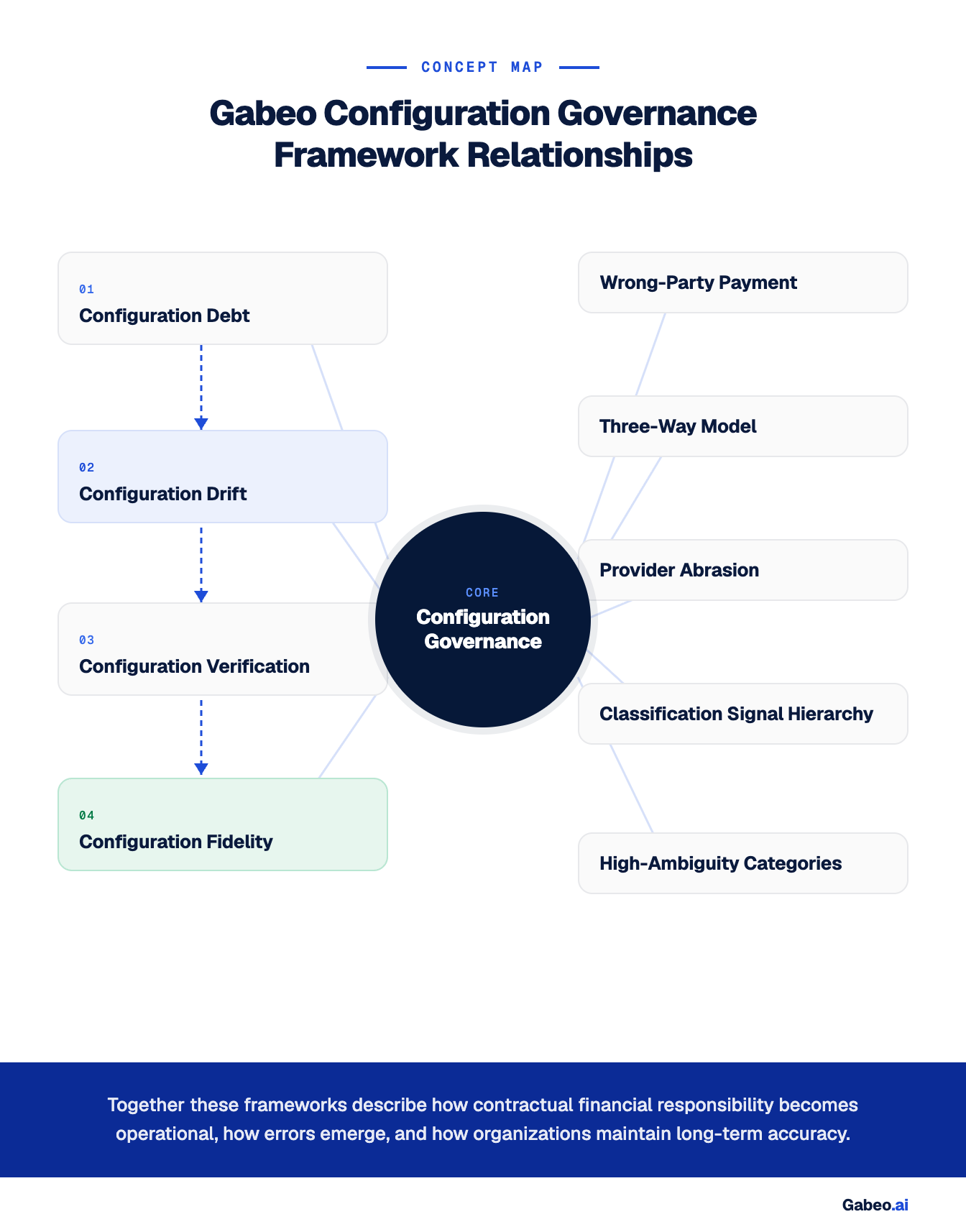
Gabeo Frameworks Index
Classification Signal Hierarchy - Which data element on a claim takes precedence when multiple signals conflict. Introduced in: Why Six Service Categories Generate Most DOFR Misclassification Errors.
Configuration Debt - Accumulated undocumented rules and obsolete overrides that erode system maintainability. Introduced in: Configuration Debt in Delegated Risk Operations.
Configuration Drift - Progressive divergence between contract terms and system configuration. Introduced in: Why Static DOFR Configuration Eventually Fails.
Configuration Fidelity - The state where every system rule accurately reflects current contract terms. Introduced in: Configuration Fidelity: How to Know Whether DOFR Rules Match the Contract.
Configuration Surface Area - Total configuration rules an organization must maintain across all contracts. Referenced across publications.
High-Ambiguity Categories - The six service category pairs where misclassification is most frequent. Introduced in: Why Six Service Categories Generate Most DOFR Misclassification Errors.
Invisible Failure Mode - DOFR errors produce no denials, no alerts, and no operational signals. Introduced in: Why DOFR Errors Don't Generate Denials.
Provider Abrasion (DOFR context) - Operational friction providers experience from incorrect responsibility assignment. Introduced in: Provider Abrasion: The Hidden Cost of Financial Responsibility Errors.
Three-Way Model - Financial responsibility splits three ways: capitated, plan risk, carved out. Introduced in: The Three-Way Model of Financial Responsibility.
Wrong-Party Payment - Claims paid by the incorrect party due to DOFR misconfiguration. Introduced in: Why DOFR Errors Don't Generate Denials.
Continue Learning
The DOFR Glossary is part of Gabeo's growing body of knowledge on delegated financial responsibility, claims configuration, and configuration governance.
If you're exploring these topics for the first time, we recommend the following publications:
Foundations
- Understanding Division of Financial Responsibility (DOFR) Agreements
https://www.gabeo.ai/dofr/articles/what-is-a-dofr-the-complete-guide - The Three-Way Model of Financial Responsibility
https://www.gabeo.ai/dofr/articles/the-three-way-model-financial-responsibility-in-delegated-risk
Configuration Governance
- Why Static DOFR Configuration Eventually Fails
https://www.gabeo.ai/dofr/articles/why-static-dofr-configuration-eventually-fails - Configuration Fidelity: Verifying Operational Rules Match the Contract
https://www.gabeo.ai/dofr/articles/configuration-fidelity-dofr-rules-match-contract - Configuration Debt in Delegated Risk Operations
https://www.gabeo.ai/dofr/articles/configuration-debt-delegated-risk-operations - The Delegation Oversight Blind Spot: DOFR Configuration Accuracy
https://www.gabeo.ai/dofr/articles/delegation-oversight-blind-spot-dofr-configuration-accuracy
Claims Operations
- Why DOFR Errors Don't Generate Denials
https://www.gabeo.ai/dofr/articles/why-dofr-errors-dont-generate-denials - Why Six Service Categories Generate Most DOFR Misclassification Errors
https://www.gabeo.ai/dofr/articles/why-six-service-categories-generate-most-dofr-misclassification-errors - Provider Abrasion: The Hidden Cost of Financial Responsibility Errors
https://www.gabeo.ai/dofr/articles/provider-abrasion-and-dofr-hidden-source-of-network-friction
About This Glossary
The DOFR Glossary is maintained by Gabeo as a living reference for delegated risk terminology. It combines established industry definitions with original analytical frameworks developed through Gabeo's research into delegated financial responsibility, claims configuration, and operational governance.
As the DOFR Resource Center grows, this glossary will continue to expand with new terms, updated definitions, and additional cross-references to help healthcare organizations build a shared vocabulary for delegated risk operations.